Week Without Driving is About Access: How the Nondriver Movement is Building Disability Power
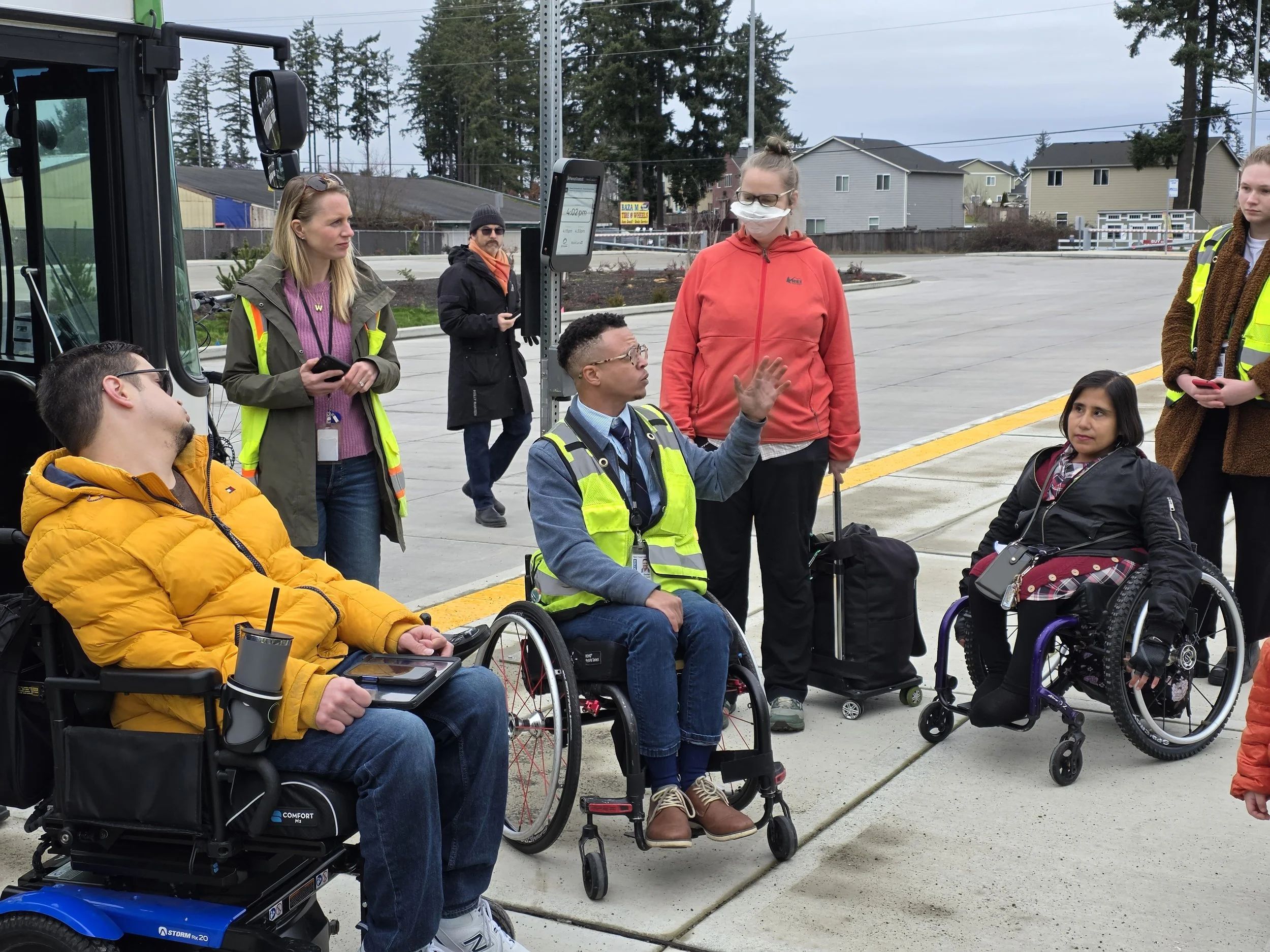
Image Credit: Anna Zivarts
Image Description: A group of people with different disabilities talking to each other at a bus transfer station.
I don’t see well enough to get a driver’s license. I was born with the neurological condition nystagmus, which makes my eyes shake involuntarily and leaves me with limited vision. This disability means that transportation access shapes — and often limits — my choices.
People with disabilities are one and a half times less likely to drive than nondisabled people, and two to three times more likely to live in a zero-vehicle household. We use transit and paratransit for a higher share of trips than people without disabilities; in fact, 73% of people with disabilities don’t drive for most of our trips.
Because communities are often designed so that driving is the only way to get places, when we can’t drive or afford a car, it can also impact our ability to find work. In 2021, the U.S. Department of Labor reported that, for working-age people receiving disability payments, 51% of people who couldn’t drive said lack of transportation prevented them from working, compared to only 31% of people who could drive.
When I was younger, I felt completely alone, deeply ashamed of my disability. Before adulthood, I only remember learning about exactly one other person with my condition. My mom pointed out another child at a community event. He was older, and I don’t think I even spoke with him.
After many years of trying to mask my visual impairment, I started being more open about it when I began working for a disability organization in 2018. There, I documented the stories of other nondrivers and, in 2024, I published a book, When Driving is Not An Option, that uplifts our transportation access needs as disabled people who can’t drive.
In sharing my book with audiences around the United States and Canada, I met many other people who, until that point, had felt the same loneliness. They shared how the stories in my book helped them see themselves as part of a much larger “nondriver” community, one that includes not only people with disabilities, but also young people, people who have aged out of driving, undocumented people, unlicensed folks, and those who can’t afford — or choose not — to drive.
Altogether, a third of people over the age of ten in the U.S. don’t rely on driving for their daily travel needs. But even though we are such a significant percentage of the population, we’re still largely invisible, our presence often measured in absences. We are the people who didn’t make it out during wildfires and flash floods, who missed our doctor and court appointments because the bus never showed up. We’re the ones who decide not to meet with a friend because there are no sidewalks in that part of town or because the paratransit shuttle can’t be scheduled at the last minute.
We must demand a world where disabled people face less isolation, where we eliminate the barriers that prevent us from getting where we want to go and fully participating in community life.
The first step is to make our needs more visible. To build toward this visibility, six years ago I created Week Without Driving, where community members commit to reduce or eliminate driving for a week. This year, it begins on October 1. The goal is to change the narrative that “everyone drives” and to show the other ways that people, especially disabled nondrivers, get around our communities. What began as an awareness-raising campaign in Washington State has grown now to include close to 800 co-hosting organizations across all 50 states. Week Without Driving is growing outside the U.S. as well.
Elected officials who participate in Week Without Driving bring attention and accountability to what many of their constituents experience every day. They see how missed connections, limited service hours, unsafe crossings, missing sidewalks and bike networks, and gaps in transit service can turn simple trips into impossible ones.
“I took on this challenge because so many of my constituents rely on public transit,” said Arizona State Senator Analise Ortiz (D-24th District), after participating in Week Without Driving in 2025. “What better way to identify solutions that people are facing than to put myself in people’s shoes and figure out for myself what it’s like to take public transit in Phoenix?”
Ortiz said her experience helped her understand the “time tax” that people who rely on transit pay when the bus takes two hours for a trip that would be 20 minutes driving. She said that the experience strengthened her commitment to fight for light rail expansion and to push back on arguments against transit expansion and affordable housing construction that are “rooted in racism and classism.”
In another region, Pittsburghers for Public Transit uses Week Without Driving to bring together a broad coalition of transit, biking, pedestrian safety, and disability groups to advocate for more funding for transit and paratransit services in communities across Pennsylvania.
“There is a lot of focus on providing bare minimum transportation options for people with disabilities to get to medical appointments, but there’s more to disabled life than seeing doctors,” said Alisa Grishman, a board member of Pittsburgers for Public Transit and the director of disability advocacy group Access Mob Pittsburgh, part of the coalition that organizes Week Without Driving in that city. “We look to elevate alternate transportation options for everyday activities like shopping, visiting friends, and attending events.”
In more rural areas, that bare minimum may not even be available. A Montana resident interviewed in a segment covering Week Without Driving in the state noted that doctors are so far away that it’s necessary to save for months to afford travel costs; they delayed cancer care due to those barriers. These stories are especially important at a time when budget shortfalls mean Montana nondrivers face further reductions in transit service.
In Dallas, Texas, disabled filmmaker Maddy Ullman documented her experience with broken sidewalks, leading to a collaboration with Dallas Bicycle Coalition to encourage advocates to use storytelling to secure more accessible communities.
This kind of collaboration between disability groups and transit, biking, and walking advocates is another important impact of the Week Without Driving. My colleague Cecelia Black and I have worked to change the narrative in Seattle to emphasize that sidewalks are vital by cultivating relationships and joining coalitions with non-disability focused transportation groups.
Initially, we faced skepticism from the other advocacy organizations about our efforts to focus on sidewalk accessibility (likely because disabled people who relied on accessible sidewalks to safely navigate the city weren’t at the table when priorities were initially set). But over the last six years, our efforts to change the narrative have paid off. During debates over Seattle’s transportation levy in 2024, many other transportation groups joined us to successfully push for an additional $150 million in sidewalk funding, increasing the rate of new sidewalk construction by over 40%. One of these coalition partners, a non-disability centered biking and walking advocacy group, is coordinating the ongoing advocacy needed to secure additional funding to complete our sidewalk network.
Building coalitions both within the disability community and with partners who don’t yet understand how to include accessibility and disability priorities in their work takes time and isn’t always easy. But Week Without Driving is a useful collaborative tool for this work. And because so many of us, both within the disability community and outside of it, are impacted by barriers created by car dependency, this initiative offers us a chance to build relationships and power, all while amplifying our demand for more accessible communities.