For Refugees With Disabilities, Language Access Is a Matter of Life and Death
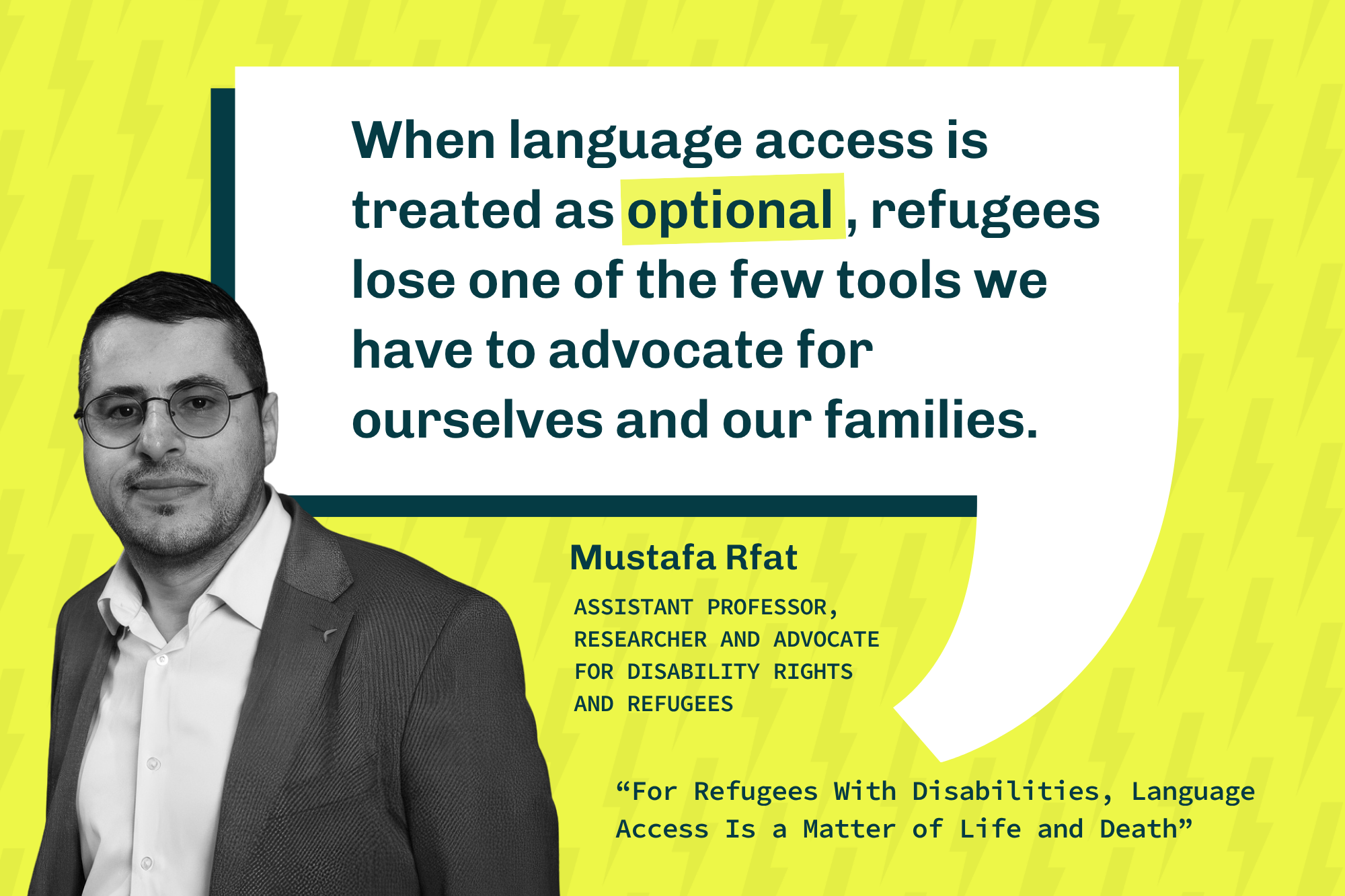
Graphic Credit: Jennae Petersen | Photo Credit: Council on Social Work Education
Image Description: Graphic features a quote by Mustafa Rfat that reads: “When language access is treated as optional, refugees lose one of the few tools we have to advocate for ourselves and our families.” The word “optional” is highlighted in yellow for emphasis. Below the quote, Mustafa Rfat is identified as an assistant professor, researcher, and advocate for disability rights and refugees, and the title of the accompanying piece is “For Refugees With Disabilities, Language Access Is a Matter of Life and Death.” The quote appears inside a large white speech bubble on a bright yellow background with a subtle lightning-bolt pattern. On the left side of the graphic is a black-and-white portrait of Mustafa wearing glasses, a suit jacket, and an open-collar white shirt, facing the camera with a slight smile. The design uses dark teal typography and a large white quotation mark shape framing the text.
For refugees and immigrants with disabilities in the United States, some of the most dangerous obstacles in our lives are invisible. We often receive medical care without qualified interpreters, experience communication breakdowns during encounters with law enforcement, and must navigate immigration systems that require life-altering decisions in languages we do not fully understand. For us, language access can mean the difference between safety and vulnerability. When refugees cannot communicate effectively, the consequences can be deadly.
In 2025, Nurul Amin Shah Alam, a Rohingya refugee who was nearly blind and spoke no English, became lost and entered a neighbor’s property while using a curtain rod as a walking aid. The homeowner called the police, and when Shah Alam could not understand or follow officers’ commands to drop the rod, police used a Taser and physical force before arresting him, according to his attorney. Following his arrest, Shah Alam remained in government custody before being transferred to U.S. Customs and Border Protection.
On February 19, 2026, Shah Alam was released — then left outside a closed coffee shop approximately five miles from his home. Agents did not notify his family or attorney; in fact, they were outside the Erie County Holding Center waiting on him. He never showed. Shah Alam was found dead in the street five days later.
“I apologize for my husband’s mistake that he was lost, that he ended up at a house, that he didn’t listen to the cops,” Shah Alam’s widow told reporters. “But to be fair, he didn’t understand anything.”
His death was not the result of a single misunderstanding. It followed a chain of institutional failures: police interpreted disability- and language-related confusion as defiance; and the legal and custodial systems failed to ensure that he could communicate meaningfully with law-enforcement, court, and immigration officials, which ultimately left a nearly blind refugee alone in an unfamiliar location.
Shah Alam’s death raises urgent questions about police responses to disability-related confusion, communication access throughout the criminal legal process, and immigration agencies’ responsibility to release people safely.
As a disabled refugee who speaks Arabic and Turkmen, I learned early what language barriers mean: having to navigate systems where I could not fully understand what was being said while still being expected to advocate for my needs. Despite how essential language access is to navigating the refugee resettlement system, qualified interpreters and translated information are inconsistently provided. Implementation varies across agencies and often breaks down at the very moments when people are most vulnerable. When language access is treated as optional, refugees lose one of the few tools we have to advocate for ourselves and our families. And for refugees with disabilities, the consequences are severe: without clear communication, many cannot obtain medical devices, mobility aids, or the basic care we need to survive.
Shah Alam’s death is not an isolated tragedy. In my own experience navigating social services in the United States, including healthcare and the refugee resettlement system, I was often expected to make critical decisions without proper interpretation, such as when communicating with a law enforcement officer, signing a lease, or explaining complex trauma to a healthcare provider. I have seen how this same failure plays out for others. In my doctoral research at Washington University in St. Louis, I met a Deaf woman who arrived in the United States while pregnant. For months, she tried to schedule appointments with her obstetrician and repeatedly requested an Arabic Sign Language interpreter. The clinic told her, again and again, that none were available. When her pain became unbearable, she agreed to be seen despite being unable to understand or communicate in her own language. It was too late. After an examination, the doctor discovered that her baby had died.
That child should still be here. And so should Shah Alam. A humane and rights-based response in his situation would have looked very different. When a resident reported an unfamiliar person on their property, dispatchers could have sent a trained civilian crisis responder, social worker, or disability-informed emergency team rather than beginning with an armed police response. If police involvement was necessary, officers should have used de-escalation, secured qualified language assistance, and recognized that Shah Alam’s inability to follow commands could reflect visual disability, disorientation, trauma, or a language barrier rather than assuming criminal defiance. Communication support should then have followed him through questioning, court proceedings, detention, and release. And before releasing him, immigration officials should have recognized his disability, confirmed his address, notified his family or attorney, and ensured that he arrived home safely.
Language access is not a courtesy or optional support service. For refugees with disabilities, it is a matter of safety, dignity, and legal rights. Under the Americans with Disabilities Act (ADA), healthcare providers, government agencies, and other public-serving organizations are required to ensure “effective communication” — including providing qualified interpreters and communication aids when needed — to all people with disabilities regardless of citizenship status.
Federal civil rights protections also require many federally funded programs to provide meaningful language access to people with limited English proficiency. But guaranteeing a right without enforcement is meaningless. Federal agencies, healthcare systems, and immigration programs must treat language access not as an optional service, but as a non-negotiable legal obligation. This means funding qualified interpreters, including sign language interpreters for non-dominant languages, and holding institutions accountable when these services are denied.
Until these systems change, stories like Shah Alam’s remain far too likely to continue. Preventing another tragedy requires more than interpreter hotlines and occasional police training. It requires making trained civilian and disability-informed responders the default for calls involving disorientation or communication barriers when there is no immediate threat of violence, guaranteeing communication access throughout law-enforcement and immigration proceedings, requiring safe release planning, and holding agencies accountable when disability and language needs are ignored. Silence, when left unchallenged, becomes de facto policy. What we choose to hear, and refuse to ignore, will decide who gets to survive this system.