All About The U.S. Political Model of Disability
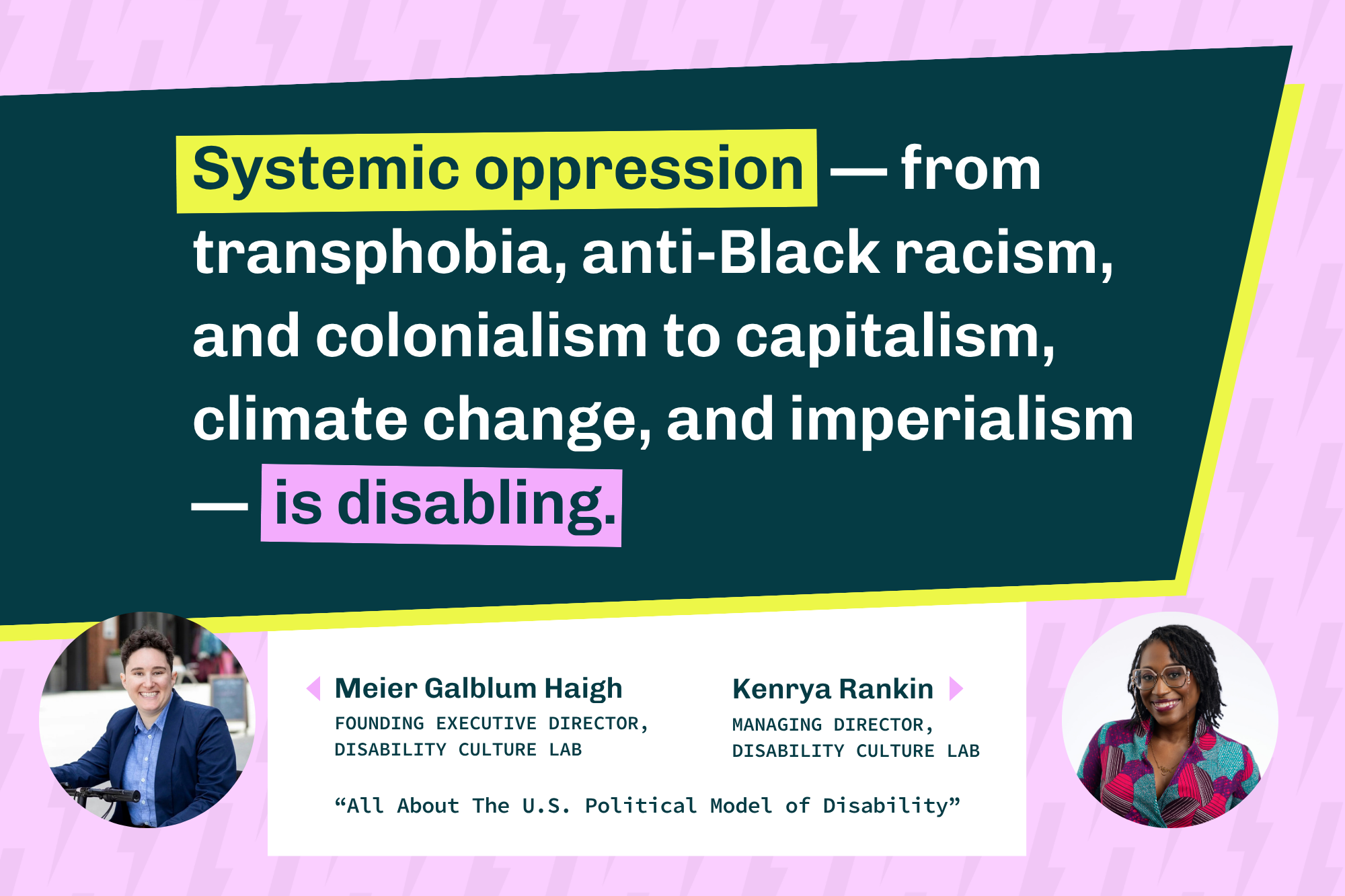
Graphic Credit: Jennae Petersen
Photo Credits: Kea Dupree-Alfred for Kea Dupree Photography
Image Description: The graphic features a quote from Meier Galblum Haigh and Kenrya Rankin: “Systemic oppression — from transphobia, anti-Black racism, and colonialism to capitalism, climate change, and imperialism — is disabling.” The quote appears in large white text on a dark teal panel, with “Systemic oppression” highlighted in yellow and “is disabling” highlighted in pink. Below, circular portraits of Meier Galblum Haigh (a white trans-masc nonbinary person with short cropped dark curly hair in a masculine blue suit and light blue linen shirt) and Kenrya Rankin (a dark-skinned Black woman with dark brown locs, wearing rose gold glasses on a chain, purple lipstick, and a shirt with a hot pink, purple, and teal print) flank a white panel identifying them as the Founding Executive Director and Managing Director, respectively, of Disability Culture Lab. The panel also lists the title “All About The U.S. Political Model of Disability.” The background is light pink with a repeating lightning-bolt pattern and yellow and pink accent lines.
Disabled people have always existed in every community, and always will. Disability is a natural part of being human, and it isn’t inherently negative or positive. Most of us will experience disability in our lifetimes, either permanently or temporarily.
But that isn’t the whole story, because disability is not equally represented across every community. Racialized and otherwise marginalized communities, especially those we see deeply scapegoated by politicians and in the media, experience disability at rates far higher than average.
The U.S. Political Model of Disability is a new model of disability developed during Disability Culture Lab’s Disability Community and Movement North Star Visioning that puts words to a disability pathway that many people who have already been pushed to the margins follow. It expands on similar models established by academics in Zimbabwe and South Africa and speaks to the ways systems of oppression and power impact who is and isn’t disabled.
Systemic oppression — from transphobia, anti-Black racism, and colonialism to capitalism, climate change, and imperialism — is disabling.
Decisions on who becomes disabled, and who does not, are often made for profit and power in corporate boardrooms, the halls of Congress, state legislatures, and city halls. They are also made by abusive spouses, racist police officers, and perpetrators of hate crimes. While disability itself is neutral, disabling others for profit, convenience, or hate — whether by policy or personal violence — is an act of harm.
Too many of our journeys into disability identity include trauma; hate crimes, gender-based violence, state violence, corporate neglect injuries, COVID-19 infections, disabilities acquired while crossing borders to reach a safer home, pollution, and so many other acts of oppression can lead to disability. And billionaires and multi-national corporations join forces with their enablers in government to shape and define who is and is not disabled through systems of power, violence, and plunder.
Multi-national corporations and billionaires are engaging in the same sacrifice zone politics that have existed since the founding of our nation, stealing both the health and wealth of communities, and using it to subsidize their own profits. Disability is expensive, and when it’s extended over entire families, communities, and kin-networks, the result is mass health theft and wealth theft. And it’s being condoned and facilitated by elected officials across our country and world.
While one in four people is disabled across the United States, more than 50% of trans folks have a disability, and 30% of both Black and Indigenous women are disabled. These numbers include higher rates of heart disease, connective tissue disorders, autoimmune disorders, and cancers. In addition to medical bias, environmental racism, and poverty, studies show that the chronic stress of oppression is making us sick. Scientists point to inflammation as a driving factor, and journalism, research, and lived community experience point to police violence, pollution, hate crimes, workplace injuries, and more.
Meanwhile, rising rates of poverty in many multi-marginalized communities make it increasingly difficult to avoid disabling jobs — especially in a country that ties healthcare to employment.
Living with the day-to-day stress of ideological, institutional, interpersonal, and even internalized oppression (where we begin to believe the false stories that we’re told about ourselves and our communities) causes deep health disparities for those subjected to it. This compounds for multi-marginalized people, including Black women, disabled trans folks, Indigenous women and Two-Spirit folks, and immigrant women) and it worsens over time, as the stress of multi-generational oppression negatively impacts both maternal health and infant outcomes.
It all comes down to this: The United States’ well-constructed web of systemic oppression means that we do not all begin life with an equal chance of being born or becoming disabled, and our paths are often chosen for us. Those paths are dictated by the profits and power of people we have never met.
When we know that oppression is disabling, we also know that every social justice issue is ultimately a disability issue. Because the end of every oppression story is a newly, or further, disabled person. And when we’re clear on that, then we then know in our bones that the only way that any of us can get free is if people from all corners of justice movements come together to get us all free.
Living into the principles of disability justice — including interdependence, commitment to cross-movement organizing, and leadership of those most impacted — is how we build a new world that values all oppressed people and takes away governments, corporations, and billionaires’ power to disable us en masse.
You in?