Queer and Trans in Iowa, 2026
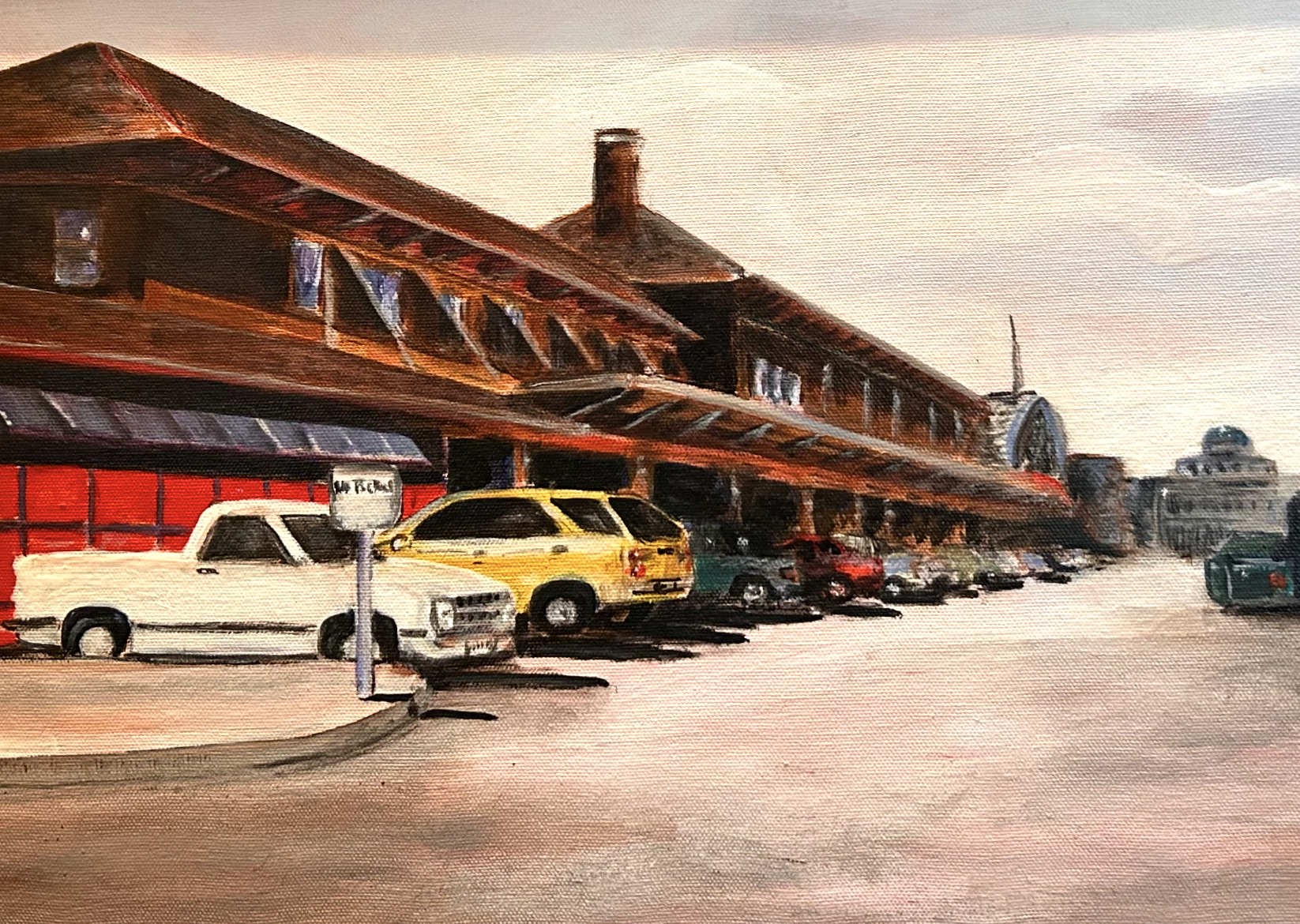
By Jean Shelton
Image Description: A painting of downtown Des Moines, Iowa by Jean Shelton. The painting shows several cars of various colors parked in front of a brown train depot. A gray government building is located at the end of the road.
There are some things you should know about me before you decide to continue with this short story. Not because I am worthy of space in your memory, but because I want there to be honesty between us.
Though looking at me, I may appear sound and sane, I have been broken in ways many would call disability, mentally distorted in ways some would name madness, and traumatized in ways most people refuse to witness.
My body provides some comfort and a sense of home, yet it also bears stretch marks diagnosed as “obesity,” carries itself beneath my burden of gender dysphoria, aches from chronic pain, and trembles from chronic illness.
In many ways, I have lived a life of privilege, provided the resources and encouragement to pursue myself. Yet, at the same time, I’ve known exile, encountered hatred, experienced abuse first-hand, and survived.
The disabilities that impact me most come from a trauma that is too heavy to hold, too searing to look at directly. But my trauma is nothing compared to what is happening all around me. I know that comparing is useless, but I can’t help myself from looking outward.
For the last several years, I’ve lived in a state of mourning, roaming between the many faces of grief and resistance. Emerging from the cold winter, my skin glows pale white, but the people I love have been disappeared all the same.
I live in Iowa, which made history with the passing of its terrible Civil Rights Removal Act in 2025 — an act that erases gender identity as a protected class at the state level. This act reminds genderqueer and Trans Iowans that we have never truly been safe.
As if we ever forget. As if moving through the day-to-day realities of our lives is not evidence enough that we are outsiders looking for a family and community that can hold our multitude, a home that might not have been built for us, but shelters us all the same.
Trans lives across the state have already been endangered by the threat or reality of eviction, homelessness, job loss, poverty, and other forms of state sanctioned discrimination. Those of us who could leave are gone. Those of us who couldn’t continue fighting.
Many of us have stopped taking medications that affirm who we are. Sometimes by force and lack of options, but just as much out of fear about transitioning in a place that keeps pulling us back. Chronically ill/sick folks know how dangerous it can be to stop taking medication.
Laws like this govern our livelihood, but they also train us to police ourselves. For the past six years — but in truth, much longer than that — queer and Trans Iowans have learned the importance of selective visibility. But some of us are always visible, unable to hide.
We retreat into our safe spaces, or whatever spaces we can find that offer some semblance of safety. We cling to the people we trust who have cared for us, who we hope won’t turn away like so many others. Or we wrap our arms tight around ourselves, withdrawing ever inward.
Our stories matter because queer and Trans people are vital, because queer and Trans joy can transform the world, because we have found secret routes out from the darkness to keep ourselves alive. They matter because queer and Trans oppression does not exist in isolation.
All queer and Trans people are impacted by the wave of conservative backlash resurrecting regressive gender norms, but transphobia has thick roots in the eugenic ideologies of ableism/sanism, the colonial, capitalist exploitation of white supremacy, and many other systems.
Impoverished people and disabled people are among Iowa’s most vulnerable. People of color and immigrants also grappling with escalating forms of violence have been made vulnerable on multiple fronts, and resources are scarce.
Queer and Trans people impacted by sexual and domestic violence find it ever more challenging to escape abusive partners, seek out life-sustaining resources, and build lives free of harm. For some of us, abusive partners may be the only family or support we still have.
City councils and municipalities across the state have responded to this legislation by advancing local protections to limit the harm people will experience, but the state legislature is pushing through another poorly-written, bad faith bill limiting their power to do so.
I can recall a time when conservatives touted the virtue of small government and local power. It is obvious now, as maybe it always was, that they only care about small government when they aren’t the ones making decisions. They are further seeking to undermine local civil rights commissions, supplanting them with centralized power that makes our cities more dangerous, less responsive, and disempowered to resist. It feels like they won’t stop until we are silent, still, and shamed into conformity.
But that’s not how power works, and that is not what I have seen. For every act of suppression weaponized against us, for every bit of hate spewed in our direction, for every attempt to decide what our lives should be, I have witnessed a community rising together.
I am not always able to show up because my disabilities activate when surrounded by others, even when those people are fighting to keep me or people I care about safe. My disabilities often mean that I get left behind or I opt out for my own safety and well-being.
I recall Johanna Hedva’s Sick Woman Theory, and how it described barriers that so many disabled people experience around marching in protests or other sorts of political resistance. I want to hold space for the obstacles in my path, but I must be accountable for my power.
Recently, I have been trying to do better. I have made an effort to expand my comfort zone, but it’s important to understand where boundaries hold me back and where they hold me together. I try to do all that I can while listening to my bodymind and its needs.
It is never quite enough, but it is something. I think that is a deeper lesson of resistance. We all must discover how to make ourselves useful and whole. Not productive in a capitalist sense, but useful in the sense of advancing the vision of a future where we all belong.