In Search of Trans Identity and Community in Cairo
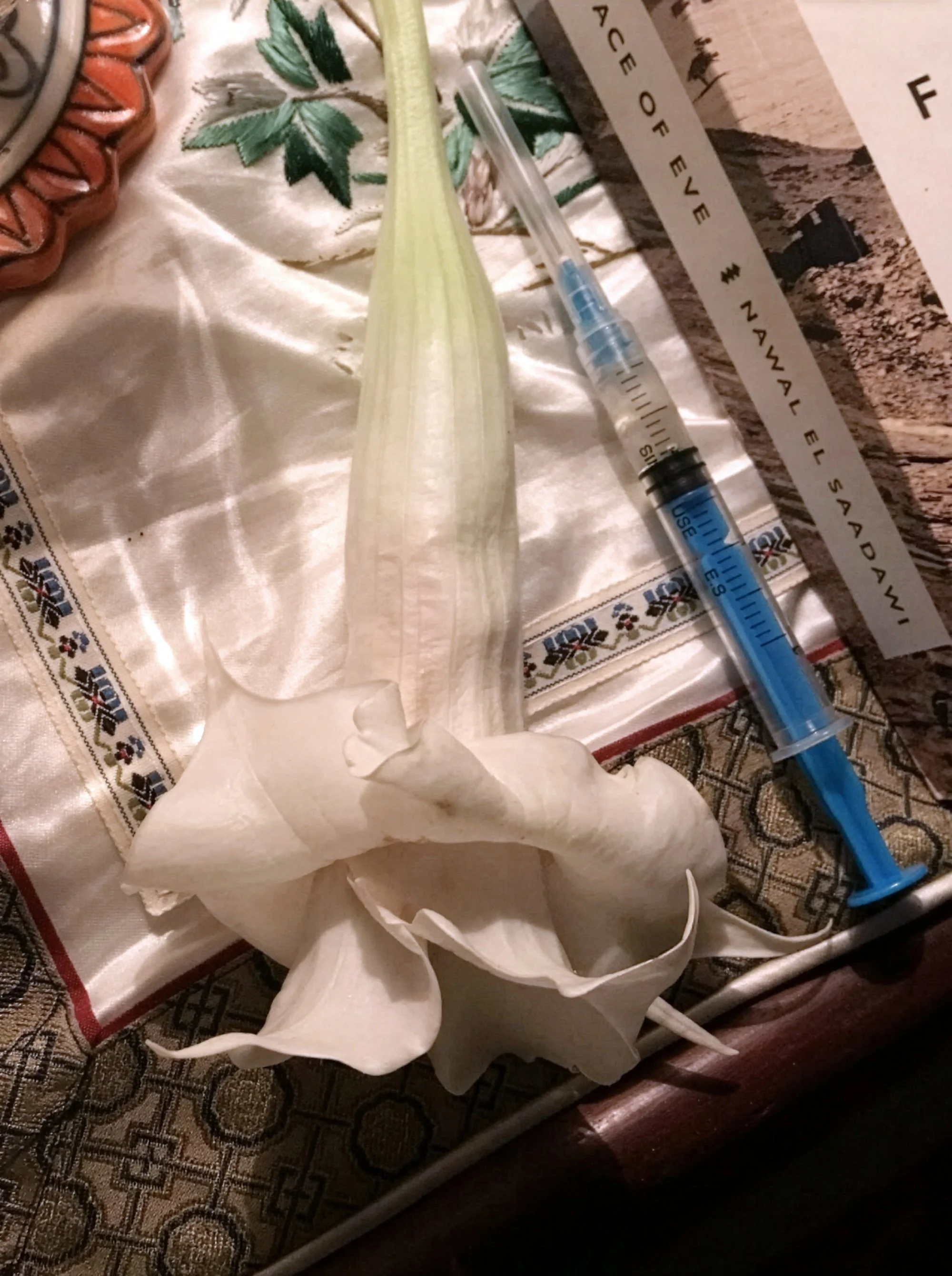
Photo Credit: Amara Refaat
A syringe, readied and laden with a routine estrogen shot, on a bedside table, sitting beside a Devil's Trumpet from Amara's backyard.
In order to have our true identities recognized by the state in Egypt, we need to be at the psychiatric wing at Qasr Al-Aini Hospital in Cairo on the first Sunday of every month, where doors open from 10 a.m. to 1 p.m.
Over the course of a year, I’ve had the opportunity to interview a number of Transgender and intersex individuals undergoing monthly consultations at this well-known — yet tragically underfunded — public hospital in Cairo’s al-Manial district. Seeing as I am Transgender and was a “patient” myself, my insider’s eye revealed a whole new world of community and acceptance in a place that sought to label us as “crazy.”
Under Egyptian law, Transgender individuals are recognized by our correct pronouns insofar as we succumb to the retrograde label of “Gender Identity Disorder,” which, in an odd twist of irony, grants us legal and medical reprieve by way of government-stamped documents with the correct gender markers and access to regular consultations with a medical professional.
As I returned to the ward month after month and saw first-hand just how special it was, making a short documentary film was simply an opportunity I could not pass up. I screened it in Germany as part of CQS Berlin’s Queer Cinema as Resistance, a joint Erasmus+ program. My footage showed friendships blossoming, and even a rivalry or two, in a space that offered us more than just paperwork. It offered a chance to network, be seen, and express ourselves in nominal and minute bouts of freedom.
From the outside, judging from some of the passerby’s jeers, we must have looked like the cast of Girl, Interrupted. We were meeting in the psychiatric wing, so of course we must have been “crazy” — holding the clinic there came with its own set of built-in connotations. It was clear that, regardless of our actual psychiatric backgrounds, the insistence on labeling transness as an illness rendered us all “insane” in the eyes of the state, and therefore society. While it was arguably not the right place for a bunch of Transgender people to be just because we needed a tiny piece of stamped paperwork, I felt strangely at peace spending time with other outcasts of society.
The Trans “patients” who attended the monthly consult were evenly divided between Transfemmes and Transmascs. Their ages ranged from 19 to 53, and there was even a foreigner or two among them. And no matter how strange and unfamiliar someone seemed, they all extended helping hands to one another.
Many of the patients commute from Upper Egypt or the Delta region, leaving before dawn, traveling miles and miles away, scrounging up the money for third-class train tickets. An overwhelming number of the people I spoke with were from various governorates around Egypt. The governorates, excluding Alexandria, are regions, towns, and cities outside of Cairo proper that are largely steeped in poverty, which makes hailing from one a class-demarcator in itself. Naturally, this comes with its own set of stereotyping and stigma. Individuals with effeminate characteristics told me that they faced significant hardships on their commute, often braving harassment on the train or needing to elude their families back home.
Once they got to the hospital, though, it was a different story. Bearing witness to such a unique display of open queerness and community in the heart of Cairo, I felt it crucial to document the process however I could. And so I filmed, as roses sprouted out of the harsh concrete before my very eyes.
I firmly believe in the becoming; that through being perceived as disabled, we become just that. And I have witnessed, before my very eyes, the resilience wrought within us by virtue of being excluded … by being abnormally alone. By being different.
Many of the individuals that I met and interviewed were uncharacteristically sane as far as cis-society would be concerned.
Those who were passing lived nominally comfortable lives so long as their IDs and paperwork were in check. I met one Trans boy who worked as a delivery driver. No one ever batted an eye. Another girl was quite the breaker of DL men’s hearts all around Cairo, while another was a model who got booked internationally.
Not everyone was so lucky, however. Many were escaping borderline-dangerous households and had anxiety and no support systems. They would commute for hours, despite being tight on cash and jobless for the foreseeable future.
Having an ID that matches our name and gender presentation often means the difference between financial independence and no job at all. Furthermore, it can ensure our safety in everyday encounters in the streets and at traffic checkpoints, where police officers are known to single us out for routine harassment, which I can only assume serves as a kind of diversion from their boredom.
In the confines of this little psych ward, in an infamous Cairo hospital, the lines were blurred. For the very few times in Cairo queer history, the stark lines drawn by economic class were blurred. People came together, and really got together for one common goal: a state-stamped paper that calls us “crazy,” but is supposed to keep us safe at the same time. Whether you pass or not, if you have documents to prove your “condition,” you are let off the hook.
Congratulations: Your identity is now legally binding.