How Long COVID Redefined My Creative Practice
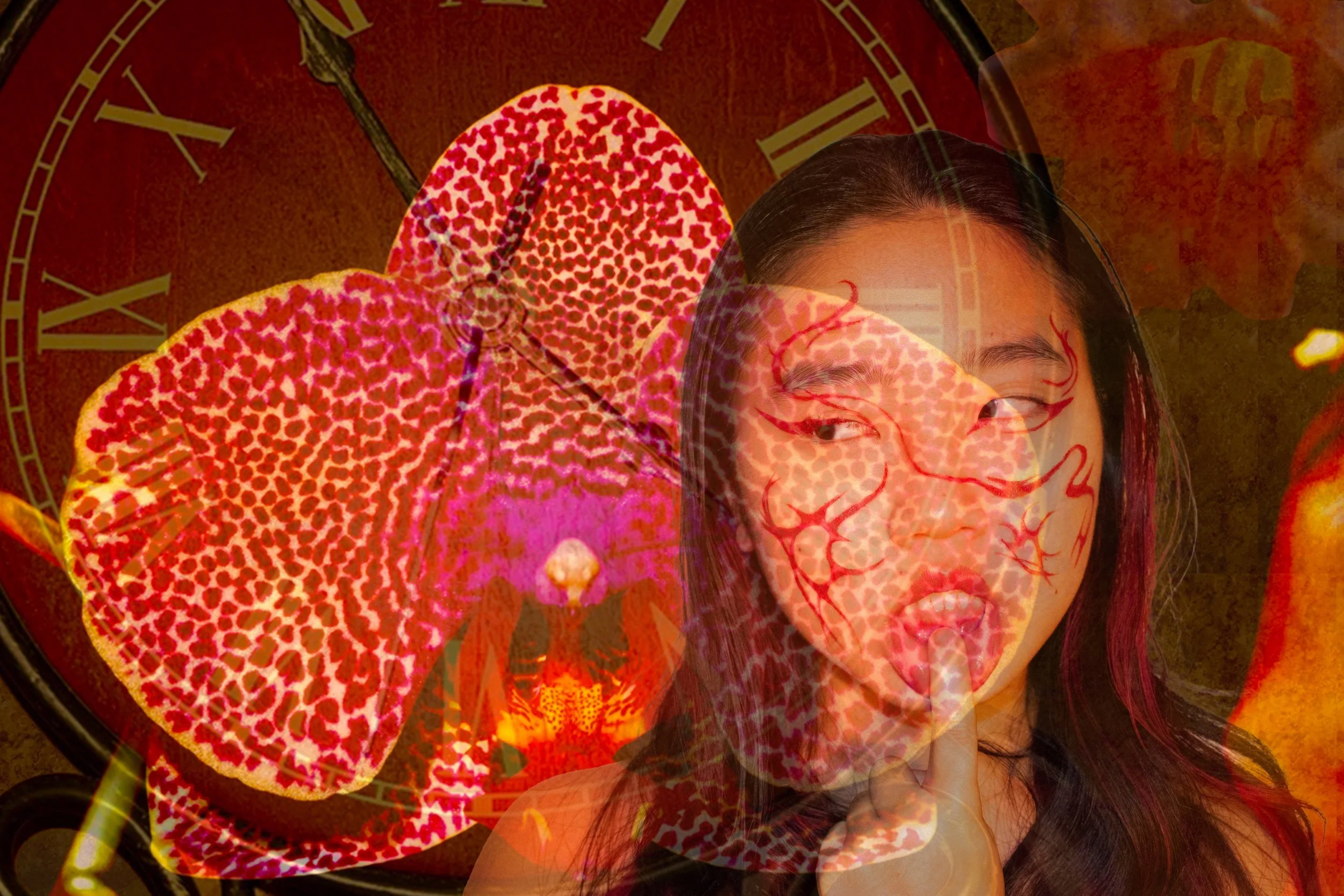
Art by Gwendolyn Hill. "time pull 1.1" is part of a photo series of three warm-toned mixed-media self-portrait collages using digital photos, scanned scrap paper, pieces of fabric and clothing, and original texture overlays.
Image Description: Mixed-media collage featuring Gwendolyn Hill, a light-skinned Chinese person with long, straight, black and red hair and bright red, spiked abstract makeup all over their face facing front while their eyes shift to their right. They are pulling their bottom lip down with one finger to show their teeth, as if mimicking the red-orange-pink spotted orchid to their right. The orchid is partially transparent and slightly overlapping their face. Behind the orchid is an orange-red roman numeral clock with gold clock hands. The upper right corner has an afterimage of a pink lily. The entire image is wrapped in warm red, orange, and yellow hues and varying textures, with the juxtaposition of the figure and orchid being the focal point.
Ever since I was young, I have had an undeniable itch to create. Whether I was throwing myself into music, visual art, jewelry making, or martial arts, I’ve constantly chased the feeling of joy that comes with creation.
As a young adult, the start of the ongoing COVID-19 pandemic was a reckoning as I was forced to consider how I would continue to create in a new world. Then Long COVID turned that world upside down. But as I look back on this past Long COVID Awareness Month, I realize that Long COVID has also opened up a journey of self-exploration, understanding, and joy through art, and prompted me to think about how we can best show up for one another.
The pandemic has proved to me that as community members, as people, we have an obligation to each other and to the earth. In 2020, I started masking out of care for myself, my loved ones, and my community members. Now, I also mask as part of my commitment to disability justice, environmental justice, anti-racism, anti-imperialism, and decolonization, because resistance is an everyday practice. We deserve to live, work, and breathe without being infected with COVID-19 and other airborne illnesses. We must find ways to create sustainably without perpetuating harm.
After developing Long COVID, my newfound tinnitus and shortness of breath meant my flute sat quietly in its case; plus band and orchestra ensembles were unsafe for me as a wind instrument player. Deep fatigue, post-exertional malaise (PEM), suspected myalgic encephalomyelitis (ME), and postural orthostatic tachycardia syndrome (POTS) meant martial arts was off the table.
In my daily life, I was pushing myself too hard. It was incredibly difficult to juggle a full college course load while trying to organize, pursue hobbies, spend time with friends, eat, and sleep, all without having my body give out. I used to think that somehow doing everything all at once was something to be celebrated, that being a perfectionist was helping my work. In truth, it was only holding me back and further disabling me.
It soon became clear that I needed to explore what it means to be creative while living with Long COVID. How do I write consistently when sometimes my arms are numb and tingly and I can’t hold a pencil, or light intolerance means I can’t stare at a screen to type? What does it look like to play the piano when my ears are ringing and my eyes can’t track quickly from side to side without triggering a debilitating headache?
Experiencing these bodily challenges prompted me to invest more in photography. At first, I started doing more self-portraiture, which helped me express the inner workings of my mind and make sense of the world around me from the comfort of my home, at my own pace. So much of art is slowing down and noticing the world around you. As someone who is neurodivergent, this is something I knew, but had not felt in such a deep way until being further disabled by Long COVID. Being more intentional with my work and how I spend my Crip Time and energy is how I honor my Crip body. I had to learn that my creativity won’t die just because I need rest. In fact, it will flourish if I allow it time to grow.
Through self-portraiture, I learned more about the realities of my chronic illness, and started drafting a new creative process for myself. It was also my gateway into subject photography. I branched out into taking photos and videos of other people, whether at mask-required events, small friend-group picnics in the park, or studios with air purifiers on blast.
This journey has allowed me to connect and collaborate accessibly and safely with fellow queer, Trans, and nonbinary disabled artists of the global majority who take COVID-19 and infectious disease seriously. We communicate about access needs, test for COVID-19 beforehand, mask, and bring air purifiers to indoor spaces. We move at the pace set by our bodies and give each other grace. It’s beautiful to experience the joy that comes when we give each other the space to fully exist as we are.
This accessible and communal collaboration has been incredibly meaningful. Paintings, crochet, and more adorn my home as evidence of us building ecosystems outside of just money. We get to redefine and build systems of trade together, and a portion of any monetary proceeds is always donated to mutual aid funds for communities in need, such as people in Palestine, Sudan, and the Democratic Republic of the Congo.
Being disabled and chronically ill is a constant state of learning from community members about how to navigate your body’s fluctuating needs and unlearning internalized ableism and state propaganda. This cycle, along with art and mutual aid, are the lifeblood sustaining our movements.
That’s why I created Gwendystar Media — a media project where I use photography, videography, writing, and more to create art and tell community stories. Through my practice, I am committed to exploring the intersection of chronic illness, disability, and art.
Truthfully, these kinds of awareness months are always filled with mixed feelings. Advocacy spaces and mainstream media typically focus on white, middle-to-upper-class disabled people with Long COVID, and not on disabled people of the global majority with Long COVID, let alone queer, Trans, or nonbinary disabled people of the global majority with Long COVID.
But in my experience, we are the very people keeping creativity alive. If there is anything being disabled has taught me, it’s that true liberation lies within what we make happen through organized struggle. In the sixth year of the ongoing COVID-19 pandemic, we are building our own systems, and shaping our own ways of interacting with the earth and each other that center disabled brilliance and leave no Crip behind.