Agency to Serve
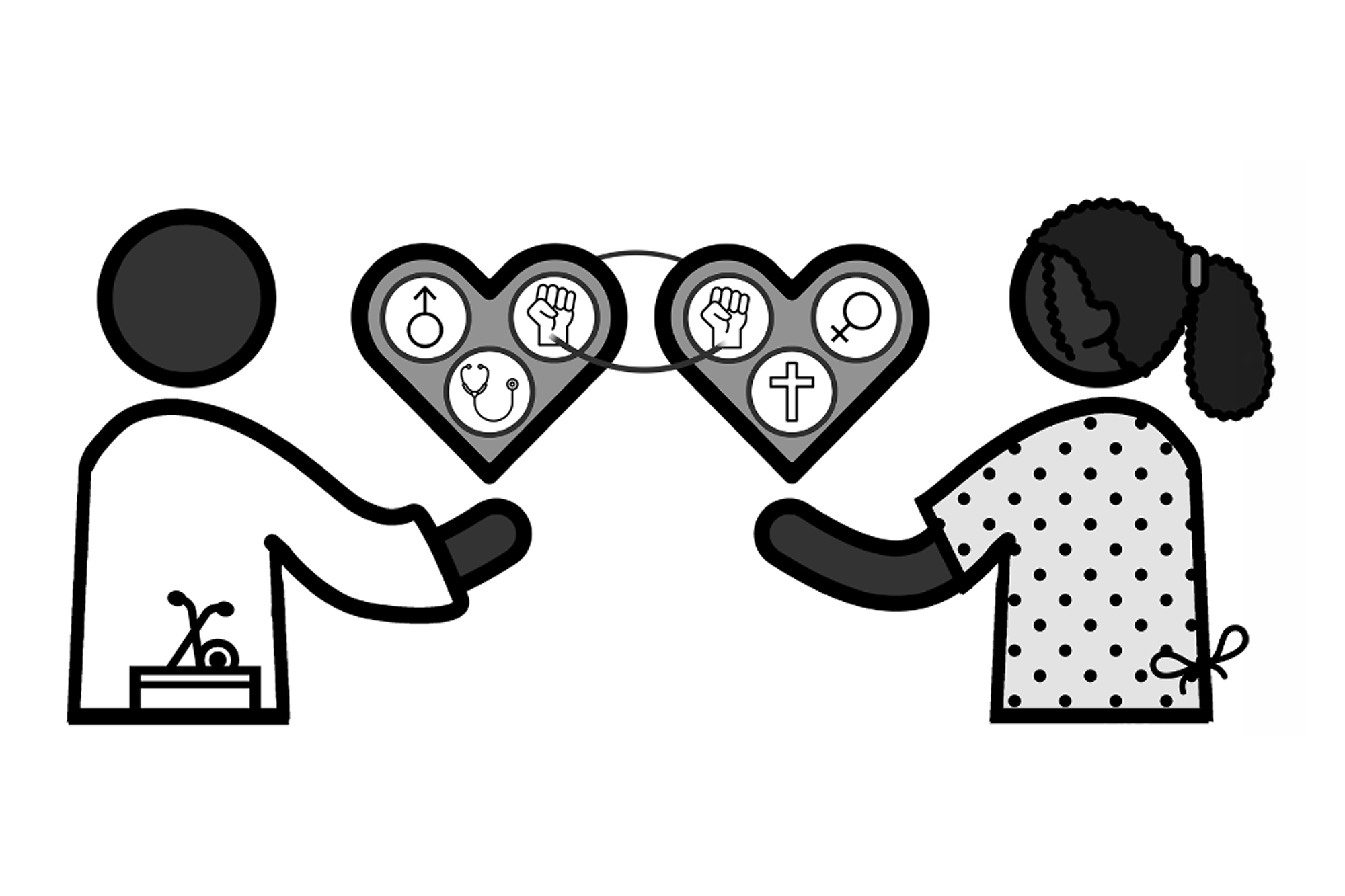
Image Credit: Agency to Serve by Tim Dyster, MedEdModels.com
Image Description: Image shows two cartoon individuals. The individual on the left is holding a heart with three symbols: Black fist, gender symbol for man, and stethoscope, while the individual on the right is holding a heart with three symbols: Black fist, gender symbol for woman, and a cross. There are lines connecting the Black fists.
*Trigger warning: This piece briefly mentions a suicide attempt; details provided related to suicide are minimized to prevent traumatization.*
I’m bipolar. My bipolar disorder is one of my greatest strengths as a kidney doctor. When I say I’m bipolar, I do not mean that I had bipolar disorder and it is now in my past. I have not overcome bipolar disorder; I live with it. I still have mood episodes. I take lithium and Seroquel every day. I was bipolar for the entirety of my medical training. Now, as a fully-fledged kidney doctor, I am still bipolar and have learned how to practice safely with those episodes. Sometimes I need more meds. Sometimes I take time away from work.
I want to show you why I say being bipolar is one of my greatest strengths. But first, I want to get some things out of the way.
Am I deeply privileged to have a great therapist who I see *twice* a week?
-Yes.
Do I have a psychiatrist I trust?
-Yes.
Do I have other marginalized identities?
-Yes, I am Black and gay. But I’m privileged, too, as a man and a doctor.
As a doctor with a disability, do I trust the healthcare system?
-Kinda, because there are disabled docs in the system and even some non-disabled people who want to do right.
With that out of the way, I have some stories I want to share with you. If you stick with me through the darkness, I promise we will end in the light.
Six years ago, I was admitted to the hospital after a suicide attempt. I was first admitted to the medical side of the hospital and later sent to the psychiatric hospital, that carceral system that we call inpatient psychiatry. As I mentioned above, I take a medication called lithium. Lithium is a very effective medication for many people with bipolar disorder. When you are on lithium, your doctors typically check the levels in your blood to make sure you are in the safe treatment range. Well, while I was on the medical side of the hospital, the medical team did not give me my lithium as they stabilized me. This was reasonable at the time because of how I attempted suicide. Eventually, I was transferred over to the psych side.
On my last planned day in the psych ward, I met with the head psychiatrist, who went over the plan to discharge me. She returned later that morning to tell me that, actually, I was not going home, and suggested that I had been deceiving her and my doctors. She had tested the lithium levels in my blood when I got to the psych ward, and they were undetectable because the medical doctors had not given me any for days. This undetectable lithium level was used against me to “show” that I was deceiving my outpatient therapist and psychiatrist and had not been “compliant” — a word I hate — as a patient. They collectively felt it was not safe for me to leave the psych ward if I was being dishonest.
I am a human with an infinite number of flaws, but I never lie to my doctors, and I take my medicine. Instead of my then-therapist or psychiatrist (both of whom I’d previously had good relationships with) calling to ask me what happened, they chose to believe the inpatient psychiatrist, a doctor they had never met. I had been their patient for four-plus years at that point. And I was also a doctor. I share this story to say: even as a clinician, I doubt what every doctor writes in the chart and what they tell me. I know that patients are the ones who actually deserve my trust. I only dig into my patients’ medical records, after I have heard from them. This practice makes me a better doctor because it centers my commitment to my patients and their truth, and allows me to come to my own conclusions as I care for them.
When I’m not kidney doctoring, I research how we train doctors. Specifically, I study something called identity safety, which centers the intersectional identities that each person brings into healthcare. It turns out that when healthcare workers leverage their identities and past experiences to help patients, it makes those workers and patients feel safer, because they feel connected and valued, and it improves patient care. Our data suggests that these moments of shared identity experiences are the driving force behind the observation that identity concordant care improves health outcomes.
We call this “agency to serve,” and it’s a key way that disabled or minoritized doctors can use our experiences to improve care for patients. To be clear, I am in no way unique as a disabled person who has felt harmed by the health system. But when I demonstrate agency to serve, these traumas transform, helping me care for, and connect with, my patients.
Years after my hospitalization, I was in the clinic with a patient with advanced kidney disease. The patient was very hesitant about taking medicine. The act of taking medication activated past trauma for this person. I shared with this patient that I, too, experience the act of swallowing medications as triggering of past harmful experiences. I shared that I take medications now because, for me, the impact of not taking medicines is worse than taking them. This patient then agreed to take their medicines and our visit ended. I spent time after that appointment wondering if I had shared too much or had been inappropriate as a doctor. At our next visit he said to me, staring directly into my eyes, “I knew there was something special about you, but I couldn’t figure out what it was until our last appointment.” I told him that I had worried I had shared too much and he instead thanked me for it. Sometimes it is the doctors who need healing.
I used to worry that people would not want to see a bipolar doctor. But I have had many patients tell me they looked me up and that they appreciated my vulnerability and openness. I am a part of an organization called Docs with Disabilities whose whole goal is to increase the numbers of disabled doctors and to make the path for disabled trainees less daunting and traumatic.
I am an infinitely better doctor because I have suffered and hurt and healed. And those dark little pieces of me? Well, they are shining through pretty brightly these days, too.