From Inside The House: How Surveillance Tech Further Threatens Independent Living
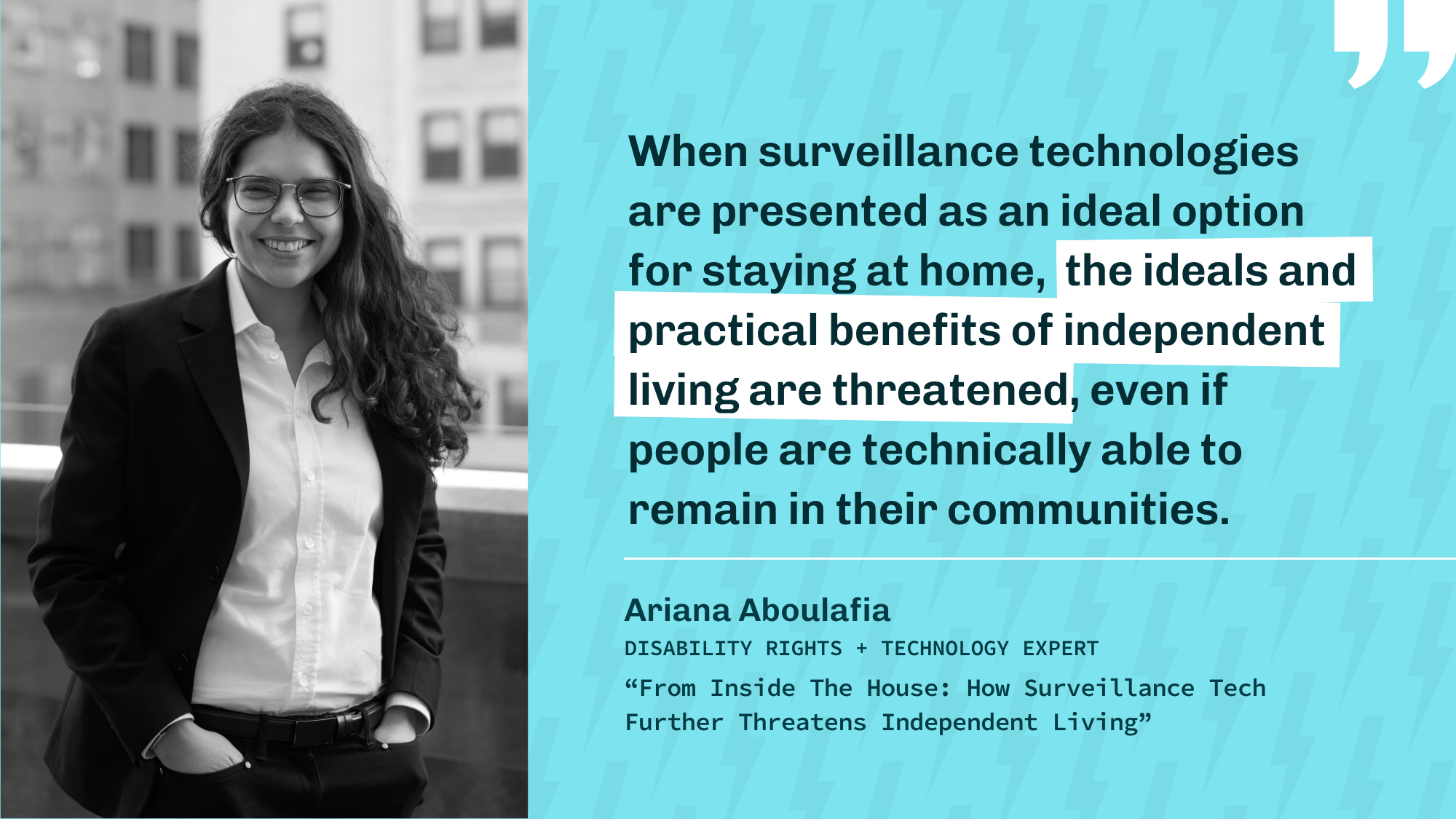
Graphic by Jennae Petersen. Photo Credit: Tim Hoagland
Image Description: A graphic featuring a quote by Ariana Aboulafia that reads: “When surveillance technologies are presented as an ideal option for staying at home, the ideals and practical benefits of independent living are threatened, even if people are technically able to remain in their communities.” The phrase “the ideals and practical benefits of independent living are threatened" is highlighted with a white background for emphasis. Below the quote, Ariana Aboulafia is identified as a disability rights and technology expert, and the title of the accompanying piece is “From Inside The House: How Surveillance Tech Further Threatens Independent Living.”
On the left side of the graphic is a black-and-white portrait of Ariana standing in front of a blurred building. She is a woman with dark curly hair and gray glasses, wearing a black suit and white shirt. The quote appears on a light blue background with a subtle lightning-bolt pattern and white quotation mark in the upper-right corner.
Independent living is under attack from all sides.
On June 18, 2026, the Department of Justice released a memo undermining decades of precedent surrounding the right of disabled people to live in our communities. The Supreme Court established these rights in the 1999 landmark decision of Olmstead v. LC, which found that, under the Americans with Disabilities Act, people with disabilities have the right to receive community-based services in the home of our choice, as opposed to being segregated into institutions. This integration mandate has become one of the cornerstones of the disability rights movement and the independent living movement, often encapsulated by the rallying cry of “Our homes, not nursing homes.” Independent living means more than living at home; the movement also focuses on autonomy, agency, and freedom of choice, which is one reason why this memo is so concerning to disability activists.
While the DOJ memo — reportedly driven by Stephen Miller — marks a direct attack on the basic rights of people with disabilities to live our own lives, policies that threaten independent living have multiplied throughout Trump’s second term. The recent cuts to Medicaid will be felt disproportionately by disabled people, and a recent presidential executive order encouraging the institutionalization of people experiencing homelessness with mental health disabilities will fast-track disabled people into institutions instead of connecting us with housing and care solutions. Further, the Trump administration is working on a rule revision that would slash or completely end the benefits of low-income recipients of Supplemental Security Income (SSI), severely harming disabled people who live at home with low-income relatives.
But independent living is also facing a threat from a less obvious source: tech tools often marketed explicitly as facilitating the ability of aging and disabled people to stay at home. Fujitsu, for example, hosts an AI-enabled platform that claims to monitor the health status of people at home, while tools like Sensi.AI claim to use “audio-based trend analytics” to allow caregivers and families to “make data-driven decisions regarding care.” There are medication management tools, like Hero Health and Medisafe, that “use machine learning to optimize medication schedules, send reminders … and alert families to missed doses,” and AI-enabled safety monitoring tools that promise to signal loved ones “when something is unusual, a missed meal, a fall, or a disrupted sleep pattern.”
The use and proliferation of these sorts of tools is being encouraged by the same administration that is openly hostile to the idea of independent living, with the Department of Health and Human Services and the Administration on Community Living having launched a Caregiver AI Prize Competition in February that provides funding support to develop AI tools that, among other things, “monitor well-being” of individuals who need in-home care.
There are also a variety of so-called companion tools, including robots, that claim to keep people at home. Indeed, the New York Times reported on the unsettling experience of an older adult with one of these companion robots. It was aptly titled, “To Stay In Her Home, She Let In an AI Robot.”
But using these tools comes with real costs.
Emerging technologies, whether AI-enabled or not, can facilitate independent living for people with disabilities. But, privacy is an integral part of autonomy and shifting power; if knowledge is power, then giving up knowledge about ourselves — particularly without our fully-informed consent — is inherently disempowering, which is at odds with the goals and foundational tenets of independent living.
Yet, essentially all of the tools mentioned above can be categorized as surveillance technologies, in that they collect massive amounts of sensitive data via active or passive monitoring and, as a result, pose significant risks to the privacy of disabled people. Furthermore, depending on the specific language used in a company’s privacy policies, the data being collected may also be shared with third parties, like other companies, to be used for targeted advertising, and data brokers who then sell that information to anyone and everyone, including government actors.
It is one thing if a disabled person fully knows, acknowledges, and accepts the privacy risks of a tool and wishes to use it anyway. But, when surveillance technologies are presented as an ideal option, or even the only option, for staying at home, the ideals and practical benefits of independent living are threatened, even if people are technically able to remain in their communities.
One way to think about this is via the “Burrito Test” — which argues that a living environment is an institution if someone is unable to microwave a burrito at 3 a.m. This test pushes us to focus not merely on what a home itself looks like, but whether the person who lives there is able to do what they want, when they want to do it. Functionally, there is no difference between not being able to microwave a burrito at 3 a.m. because an in-person watchman prevented you from doing so, or because an AI tool warned your family members about it and they then chastised you from afar. In this way, surveillance technologies are expanding the breadth and depth of the institutional panopticon.
Of course, surveillance tools are not solely the purview of at-home care; they are used in hospitals and institutions as well, and sometimes in much more obvious ways. But, the proliferation of these AI-enabled technologies in the home, encouraged by industry and government alike, requires us to invite institutions into our homes, and in doing so blurs the lines between the two with little scrutiny or oversight.
Independent living is reaching a tipping point in law and policy, and disability advocates’ commitment to protecting people’s full autonomy must be stronger now than ever. That means opposing not just federal policies that make it harder to live independently, but surveillance technologies that make people choose between maintaining their life at home and safeguarding their privacy.