Poverty Should Not Be the Price of Love
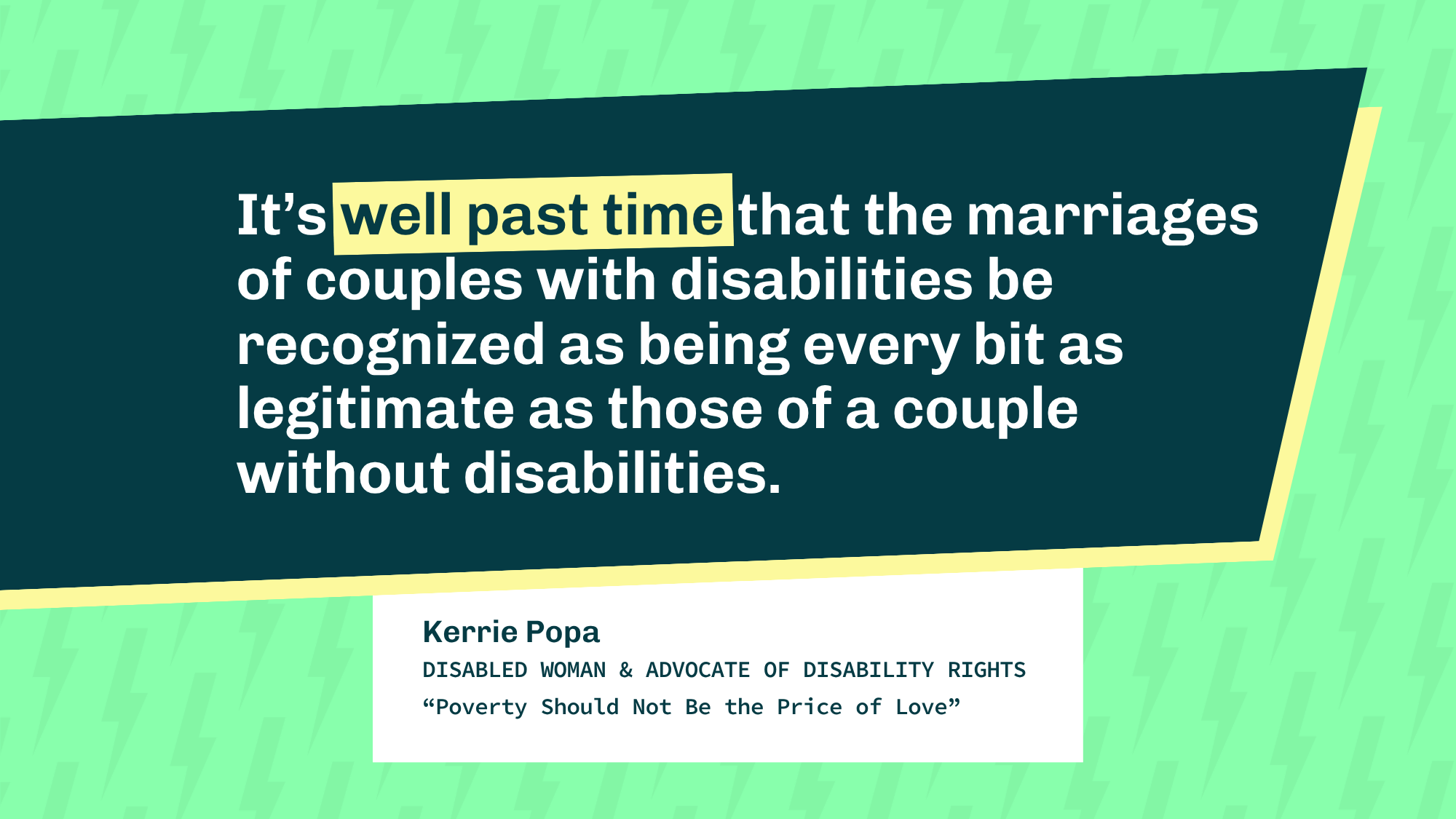
Image Credit: Jennae Petersen
Image Description: Graphic with text that reads: “It’s well past time that the marriages of couples with disabilities be recognized as being every bit as legitimate as those of a couple without disabilities.” The words “well past time” are highlighted in pale yellow. Graphic has a mint green background patterned with subtle lightning bolts. A large dark teal speech bubble contains the quoted text. Below the quote, the graphic identifies Kerrie Popa as a disabled woman and advocate of disability rights. Beneath her name is the title of the accompanying piece: “Poverty Should Not Be the Price of Love.”
As a young girl growing up without disabilities, I was taught the importance of relationships and, inevitably, I internalized pervasive societal messages about love and romance. Heterosexual love was marketed to little girls in countless ways, but especially through storytelling. The storylines have become so normalized that they cause few of us to even bat an eye; we all know the prince saves the princess and they fall in love, living happily ever after.
Predictably, I fell in love with the idea of love and proudly expressed my desire for romantic relationships. How I professed my ambition for intimacy fluctuated over the years, but the desire itself never wavered.
My relational goals aligned seamlessly with society’s expectations of me. Considering that the marriage rate of the nondisabled population exceeds 70%, dreams of becoming a girlfriend and eventual wife were ones I regarded with certainty. I thought that it was only a matter of time — not “if,” but “when.”
Then came disability.
I was diagnosed with multiple disabilities at the age of fourteen, and at that moment, my world changed permanently. I was suddenly tasked with figuring out how to pursue the same desires I had always held, but in ways that looked different from before my diagnoses. I had to determine how to meet the same needs for love, relationships, and belonging, while adapting to the limitations and barriers that society imposes on disabled people in love, romance, and marriage.
What I personally found most challenging about adjusting to life with disabilities was society’s perception of disability — its reflexive tendency to treat it as inferior and to assign it second-place status relative to nondisabled life.
Despite the Americans with Disabilities Act’s (ADA) pronouncement that “disabilities in no way diminish a person’s right to fully participate in all aspects of society,” contradictory restrictions persist. These contradictions feel most evident to me in marriage penalties, which resemble punishment for entering the sacred and culturally revered institution of marriage, and reveal a troubling bias regarding which forms of family are considered acceptable under so-called “American ideals.”
These punitive measures, which constrain the formation and stability of disabled families, can be seen in current Social Security Supplemental Security Insurance (SSI), Social Security Disability Insurance (SSDI), and Medicaid policies, each of which includes provisions for the disabled. In certain cases, the assets and earnings of a spouse count against one’s own benefits, meaning that payments or coverage may be reduced or eliminated.
For SSI (a needs-based program not tied to work history), the maximum federal benefit for an individual in 2026 is $994 per month and $1,491 per month for couples. Under this structure, it is financially advantageous for disabled individuals to remain legally separate rather than marry. In contrast to American reverence for marriage as a fundamental right, this nearly $500 marriage penalty is deeply troubling and echoes historical ideologies that rank certain relationships as more worthy than others.
Additionally, combined assets are capped at $3,000 for married couples. This means that couples with disabilities are unable to exceed these numbers in savings and bank accounts, severely limiting their financial capability to buy a home, own multiple vehicles, or even save for retirement.
For SSDI (a work-based program requiring sufficient work history), there are no asset limits, and benefits are not reduced based on passive income. However, beneficiaries must remain below a maximum monthly salary to qualify for disability benefits. In 2026, that threshold is $1,690 per month for non-blind individuals and $2,830 per month for blind individuals. Earning at or above these amounts on a sustained basis may lead the Social Security Administration to determine that the individual is no longer disabled, resulting in termination of benefits.
Medicaid eligibility varies depending on the pathway through which an individual qualifies. Not all Medicaid recipients receive SSI, though most SSI recipients automatically qualify for Medicaid. In many pathways, asset limits apply; in all pathways, income is capped. Much of the disability community relies on Medicaid to attain needed medications and services. But current policy limits often mean disabled people must choose between the person they love or the life they love — their pursuit of happiness is severely limited and their happily ever after is rendered conditional.
The financial penalties imposed on disabled people have gone unchecked for far too long. Although the ADA protects against overt discrimination in many settings, political leadership has failed to fully realize the monumental law’s goal of ensuring equal opportunities to participate in societal institutions.
As a teenager, I was deeply discouraged by the low marriage rates and the elevated risk of divorce among people with disabilities. What I didn’t yet understand were the systemic penalties embedded within public benefit structures — penalties that discourage marriage, privilege unmarried cohabitation over legal commitment, incentivize avoidance or dissolution of marriage, and reinforce structural poverty through rigid benefit cliffs. The way current systems are set up structurally enforces the devaluing of disabled marriage.
It’s quite common for couples with disabilities to delay marriage, perhaps even indefinitely, to maintain benefits. In this way, many disabled people are forced to live in fear of having their couple status discovered and penalized. Even in cases where couples assume the financial consequences of a legal marriage, the weight of this policy burden can add tremendous strain to the relationship. When spouses depend on their benefits for their livelihoods and those benefits are reduced by the other spouse’s earnings, this can create a breeding ground for resentment and monetary codependency. The addition of financial penalties for marriage adds pressure to the union, requiring certain members to take on caregiving roles and disproportionate financial responsibility, and stripping disabled people of autonomy by necessitating economic dependency on our loved ones.
While disabled couples aren’t outlawed, we continue to be punished. Disabled people’s need for financial safety and desire to share our lives with a partner we love are no different from those of non-disabled people.
Existing as a person with disabilities in a society that’s not built for you is difficult enough, and our lives are filled with difficult choices. Whether to have enough money to pay for a roof over our heads, food in our bellies, and to maintain our quality of life through our healthcare versus our spouse, are not choices that we should have to make. It’s well past time that the marriages of couples with disabilities be recognized as being every bit as legitimate as those of a couple without disabilities.
During all of the normalized health struggles, constant burdens of ableism, abundance of stress, and unending requirements for resilience, my love for my partner has managed to outshine it all. Much of my life has been tumultuous, but he has been my shining light through it all. He’s the one who keeps me going, who makes me strive to be all that I can be, and welcomes me with open arms at the end of each long day. We were married on May 2 of this year. I love him with all my heart, and my wish for other disabled people is a bond as strong as ours.
Disability is not a choice. Why, then, should the right to commit to another person come at such a cost? Poverty should not be the price of love.