Body Horror is for the Marginalized
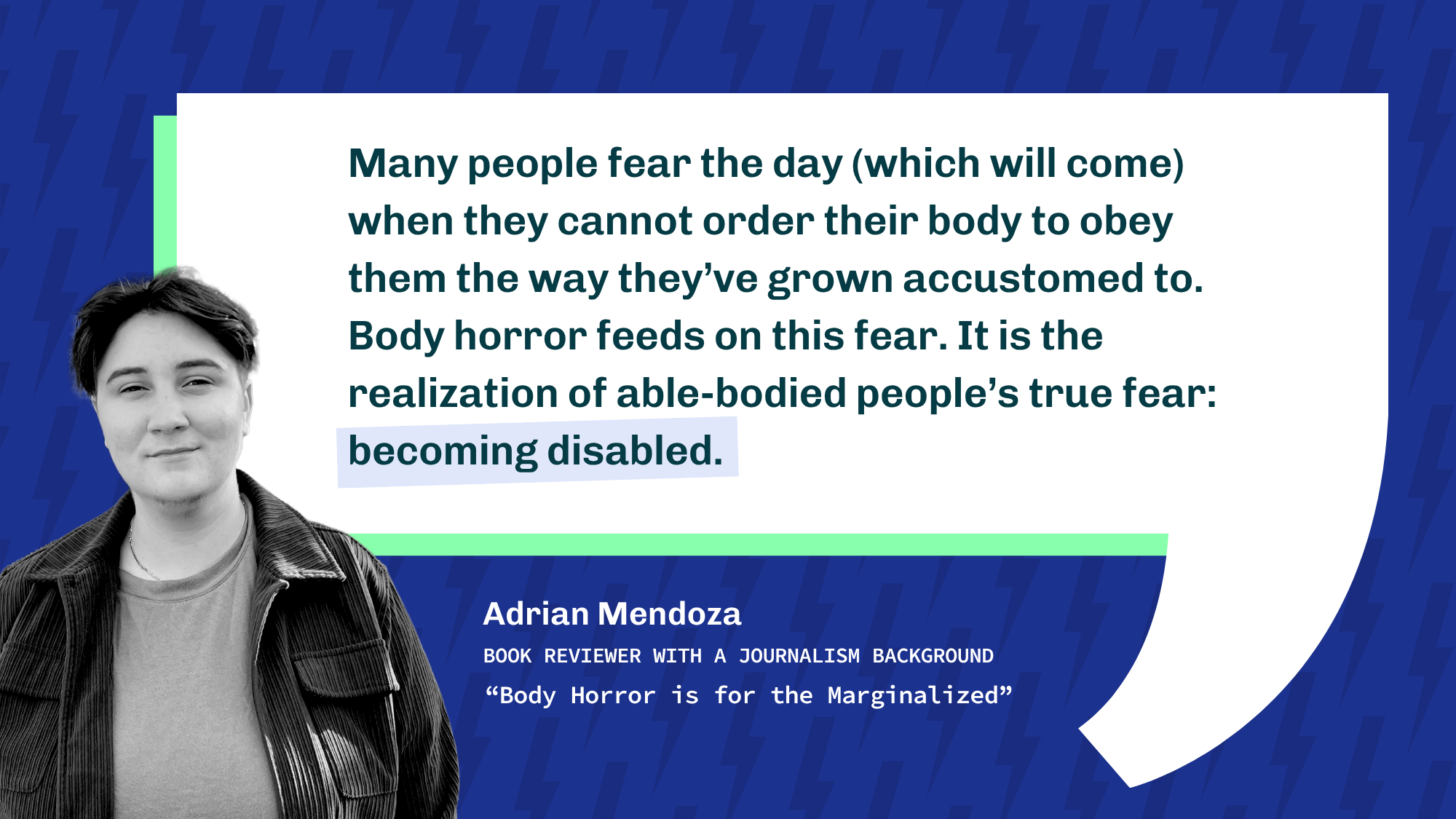
Image Credit: Jennae Petersen
Image Description: Graphic with text that reads: “Many people fear the day (which will come) when they cannot order their body to obey them the way they’ve grown accustomed to. Body horror feeds on this fear. It is the realization of able-bodied people's true fear: becoming disabled.” The words “becoming disabled” are highlighted. Graphic has a black-and-white portrait of Adrian Mendoza on a blue background patterned with lightning bolts. Below the quote, text identifies Adrian Mendoza as a book reviewer with a journalism background. The title at the bottom reads, “Body Horror is for the Marginalized.”
I have, in moments of frustration, been known to accuse my trans and disabled body of having never done me any favors. This may not be entirely true. My body houses me and sometimes listens to my requests, but it also has a tendency to act out. It seems that my body has the energy to twitch and jerk without my approval, but doesn’t want to carry my weight across a room. Then there are the days where I look in the mirror and just can’t quite pinpoint why I don’t “look like myself.”
A nice silver lining to feeling alienated and betrayed by my body is that I fucking love body horror. There is something so satisfying about reading about someone whose body turns on them in bizarre and grotesque ways. After all, I consider myself someone who champions diverse representation, and if authors and publishers won’t face the reality of a disabled queer body, the next best thing is a body queered through horrific transformation.
Andrew Joseph White instilled (a) trans experience in Hell Followed With Us by giving readers a character who is both trans and transforming into a monster by the hand of his family’s culty religious experiments. It would be reductive to say this is a simple metaphor for puberty, but it certainly speaks to my experience of watching my body turn into something I had to turn away from — something that served the wants and expectations of others, but not myself.
The thing about body horror is that it forces readers to feel the discomfort that some of us feel daily. I can explain the reality-bending nature of gender dysphoria. I can tell you that I feel as though I am running on an old battery — one without the ability to power save or recharge without doing that thing where you have to bend the wire at just the right angle after unplugging it and replugging it just to find that you had it the right way around the first time. But if you’re someone who remarkably recognizes your reflection every time as it stares back at you with the tell-tale spark of energy behind your well-rested eyes, then it might take a bit more to get the idea across.
On some level, everyone fears not being in control. It is a matter of fact that there are many things outside of our control, but it is often hard to accept that our own bodies are not entirely in our control. For the able-bodied reader, your brain is likely capable of sending your commands to your body, which will, in turn, act according to your wishes. But then think of when you get sick. Can you will your sinuses to clear and your throat to soothe itself? As time passes, can you ever truly hold onto how you looked ten years ago? It may be your body, but you are not in control. When you recognize that, you come a little bit closer to understanding my experience of disability.
Consider the familiar cultural image of a young, demon-possessed girl. From The Exorcist to the recently released book This is My Body by Lindsay King-Miller, you can expect that these stories feature a convulsing and contorting body not aligned with the young mind that lies beneath the surface, as it is hijacked by a demonic force. This image is scary precisely because it forces viewers to look at someone not in control of their own body.
The thing is, my body doesn’t need a supernatural intruder to escape my control. I walk into a job interview with my mind divided between answering the questions and keeping my tics at bay. I tell my body to sit still and relax my face into a soft, hirable smile. In response, my knee bounces, my hands flex, and my brow furrows. I beg my mouth to fall silent as I settle into a quiet room, but it has things to say and noises to make. Yet when I tell my body that it’s time to work, it seems to have exerted the last of its energy. My body is no more mine than the body filled with a demon.
Many people fear the day (which will come) when they cannot order their body to obey them the way they’ve grown accustomed to. Body horror feeds on this fear. It is the realization of able-bodied people’s true fear: becoming disabled.
It makes sense to prize control of your own body. It is the unavoidable vessel through which we conduct our lives. If you cannot control your body, it can be difficult to control your life, and many disabilities restrict the ability to conduct a body with ease without accommodation (which is concerningly scarce in everything from U.S. work culture to infrastructure).
What many people have yet to reckon with is that the body irrevocably has limits. It is also inevitably, and tragically, always going to be perceived. The alienation that comes from the bodymind disconnect of transness, dysmorphia, disability, etc., is only amplified by social forces of shame and othering.
We have a long history in this country of people being taught to believe we are subhuman simply because our bodies are othered. It’s no wonder so many have grown an affinity toward Frankenstein’s monster, who knew he had worth beyond his creator and beyond his public perception.
As I wrote above, I value representation, and for all the gore and all the monsters that we are conditioned to be repulsed by, there are those of us who actually see ourselves. We see our guts ripped out on screen, and it feels familiar. We see how others cower, and we recognize the isolation. Body horror is for the marginalized because it does the age-old act of comforting the afflicted and afflicting the comfortable.