A New Approach to Closing the Disability Wealth Gap
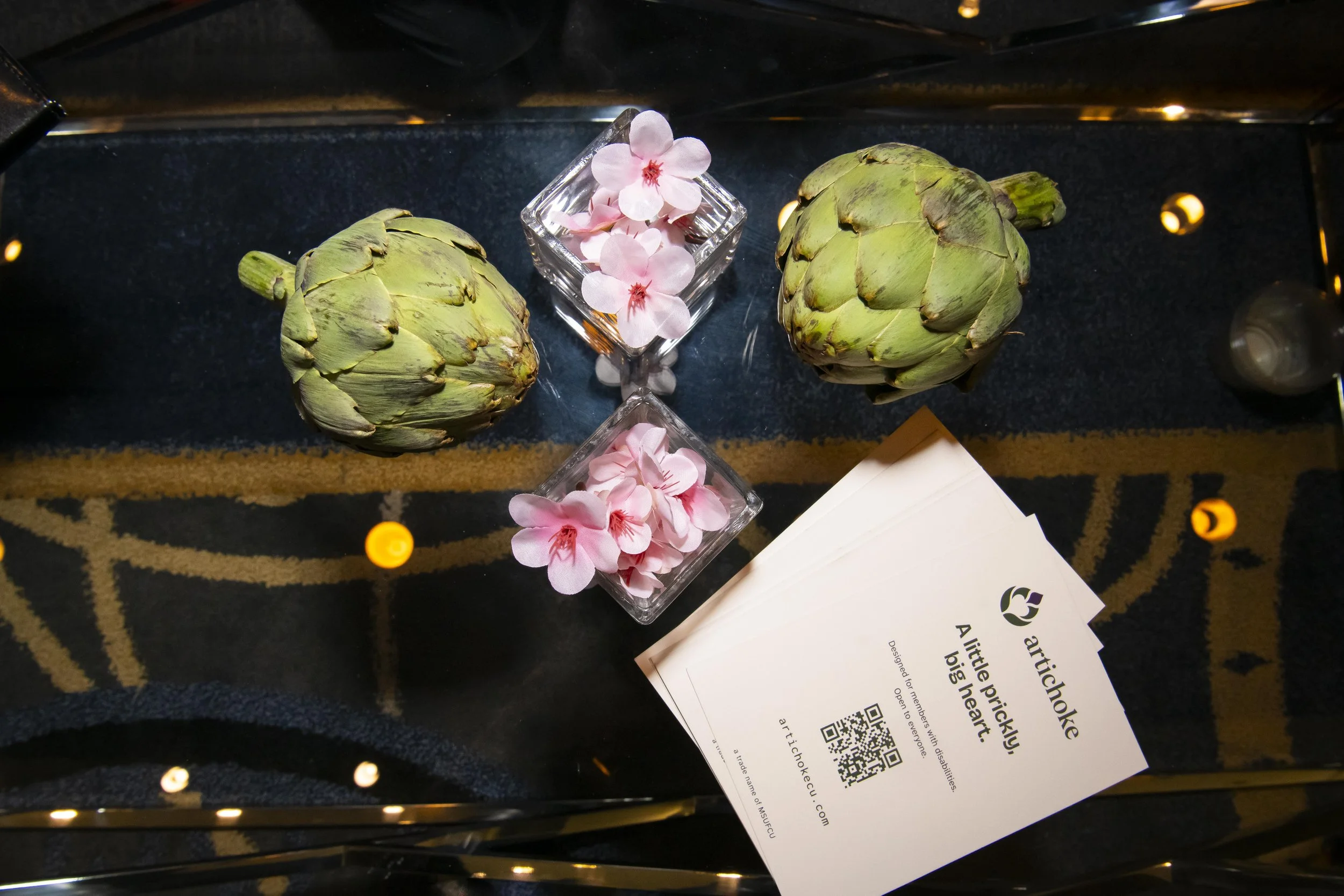
Image Credit: Ford Foundation and Jane Kratochvil Photography
Image Description: Two green artichokes sit on a glass table with small pink flowers in low rectangular vases and a card that reads, "Artichoke, A little prickly, big heart. Designed for members with disabilities. Open to everyone. ArtichokeCU.com, a trade name of MSUFCU.”
It was another financial institution’s commercial that motivated me to create something different.
Two busy white, apparently nondisabled, suburban parents were standing on their carefully manicured lawn talking about how they needed to go to the bank to plan for the future of their adult son with Down Syndrome. They weren’t asking him about his future. He wasn’t going with them to the bank. As both a parent of disabled children and a disabled woman, it made me wonder: Who was talking to him about his money? Where did he want to spend it? Was there something he specifically wanted to save for?
The existing services for this type of support fall short. In fact, banking services often fail to meet the needs of disabled people. High fees and limited access to low-cost credit are common, and there is low awareness of tools like ABLE accounts, which allow people with disabilities to save money without affecting most federally-funded benefits based on need. Across the board, there is little awareness of the diverse experiences and needs of people with disabilities, and most financial institutions are not courting us as customers.
So, in collaboration with our partners, I created Artichoke Credit Union, a first-of-its-kind credit union designed with and for the disability community. In September, Ford Foundation, Robert Wood Johnson Foundation (RWJF), and John D. and Catherine T. MacArthur Foundation announced joint funding to support the creation of this new institution. While philanthropic support provided the necessary funding to bring Artichoke Credit Union to life, it’s important that we think beyond capital.
In partnership with Ford’s Mission Investments Team, we engaged Financial Health Network, an organization in the finance sector that helps make the system more equitable for all. The goal was to conduct an in-depth landscape analysis to identify priorities, pain points, and gaps in financial services for people with disabilities. The data was sobering.
According to the National Disability Institute, nearly 30% of people with disabilities are unbanked or underbanked — meaning they don’t have a checking or savings account, or they rely on alternative financial services, like check-cashing services to access their funds — compared to 17% of nondisabled people. This analysis also found that, among unbanked individuals with disabilities, lack of trust in financial institutions is a top reason for not having a bank account. Households that include disabled people need nearly $20,000 in additional annual income to meet their needs, compared to households without disabled people. And one-third of GoFundMe campaigns are for medical expenses.
Disrespect, exclusion, and outright discrimination are still common for people with disabilities, too. Financial institutions have routinely denied us mortgages. The Small Business Administration does not include disabled people as eligible for the 8(a) Business Development Program, which helps those who are socially or economically disadvantaged compete for government contracts. And we are frequently mocked and asked to provide extra information to prove our need for support when accessing basic services.
The disparities compound for disabled women and people of color. Women living with disabilities make 56 cents on the dollar when compared to nondisabled men, are less likely to be employed, and are frequently the first employees to be let go, based on research conducted by the National Partnership for Women and Families. We are also more likely to work low-wage, part-time jobs that rarely provide benefits like paid medical and family leave and health insurance. And while 24% of white Americans with disabilities live in poverty, that figure jumps to 29% for Latine people, according to a 2019 report from the National Disability Institute, the most recent data disaggregated by race available. For Black Americans with disabilities, the poverty rate skyrockets to nearly 40%.
Coupling all of the data with years of lived experience brought the picture into focus: We needed to build something better.
A key part of that was the naming process. We needed something that communicated our values and avoided the trap of inspiration porn. Ed Roberts immediately came to mind.
I grew up in the Bay Area, and my parents were involved in the disability rights movement. By then, I knew Ed Roberts personally as the powerful head of a state agency determined to help disabled people access jobs. But I had also heard stories about young Ed, who’d been diagnosed with polio and used an iron lung. I went to Burlingame High School, the same high school he’d attended years earlier via telephone because schools were not required to be accessible. I knew that young Ed wanted the same thing all people want — access to the community, a job, a family. And yet doctors told his mother and him, “You will be a vegetable.” A statement like that is incredibly heavy and so ableist, but Ed didn’t let it stop him, declaring that he would be an artichoke.
“A little prickly on the outside, but with a big heart,” he later explained. “You know, the vegetables of the world are uniting, and we’re not going away!” And when they came together, achieving young Ed’s goals became more real for him and millions of disabled people.
Being an artichoke is such a powerful sentiment. It pushes back on stereotypes determined to keep people like me, and families like mine, out of society with a blend of defiance and snark. It shows that we have to be prepared to advocate at all times, and that we are a people deserving of care and love. And it fits so well with what we are trying to do in building infrastructure for us and by us that meets our needs.
As a credit union, Artichoke is member-owned. That means that, unlike a regular bank, this is an entity owned by disabled people, our families, and the organizations that support and serve us. Building infrastructure for our community at a moment when so many programs and services that folks depend on are under attack is key. At launch, Artichoke expects to offer checking and savings accounts, share certificates, personal loans, credit and debit cards, financial education resources, and budgeting tools. Members will also have access to support through live chat, phone, video services, and accessibility-focused features — such as account alerts, options to use supported decision-making models, and other custom-designed tools shaped by the needs of the community we serve. These services and their delivery will evolve over time and in collaboration with the community through an advisory board.
Our partner, Michigan State University Federal Credit Union, has had disabled people on its board for years and employed us long before the creation of Artichoke. Its other sub-brands have served disabled students and alumni for years. That’s key to why we chose to work together. This organization knows us. Your average financial institution is not being advised by people who have had to navigate asset limits, eligibility requirements for health care, and endless bureaucracies. But Artichoke is informed by those experiences, and people with those lived experiences will be at the table.
We designed Artichoke Credit Union so that no disabled person is treated as an afterthought in our own financial story. Member sign-ups are expected to begin early in the second quarter of 2027.
I still think about that commercial. But not with frustration. Today, I see it as a catalyst for change. Now, when a young man with Down Syndrome, or any disabled individual, thinks about our financial future, we won’t be left standing on the lawn while others plan it for us.