You Were Not Planned For: How Ableism Steals the Disability Vote
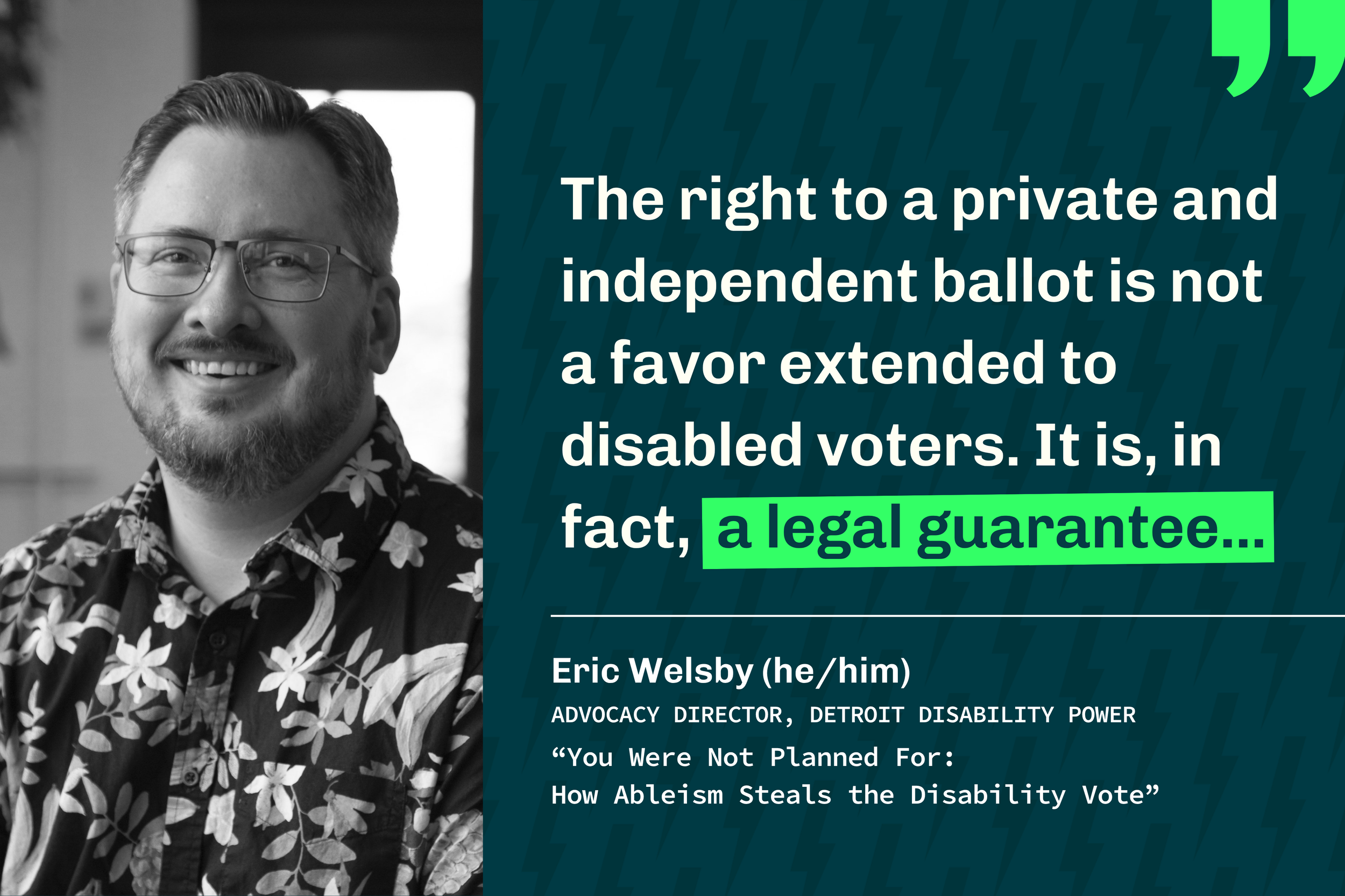
Graphic Credit: Jennae Petersen | Photo Credit: Laura Suprenant
Image Description: The graphic features a quote from Eric Welsby, Advocacy Director at Detroit Disability Power, emphasizing that disabled voters have a legal right to cast our ballots privately and independently. The quote reads: “The right to a private and independent ballot is not a favor extended to disabled voters. It is, in fact, a legal guarantee.…” Beneath the quote are his name, the designation “Advocacy Director, Detroit Disability Power,” and the article title, “You Were Not Planned For: How Ableism Steals the Disability Vote.” On the left is a black-and-white portrait of Welsby, a smiling man with short hair, glasses, and a beard, wearing a floral-patterned shirt. The quote appears in large white text against a dark teal background with a subtle lightning-bolt pattern and bright green quotation marks in the upper right corner.
There is a dumpster blocking the accessible parking space. There are headphones unplugged from the voting machine. There is a wheelchair-height voting booth still folded up in a closet when the polls open. These are not accidents. They are the texture of ableism; not the dramatic, obvious kind, but the grinding, structural kind that quietly announces, You were not planned for.
In 2025, observers from Detroit Disability Power (DDP), where I serve as Advocacy Director, visited 415 Election Day polling locations across seven Michigan counties, armed with training, challenger credentials, and a questionnaire assessing four accessibility criteria for compliance with the law: parking and pathway, entrances, wheelchair-height voting booths, and accessible voting devices (called the Voter Assist Terminal or VAT in Michigan). The bar was not high. And still, only 10% of Election Day polling locations cleared it, a statistic that has worsened every single year since DDP began formally tracking it: 16% in 2022, 13% in 2024, 10% in 2025.
The right to a private and independent ballot is not a favor extended to disabled voters. It is, in fact, a legal guarantee, protected by the Voting Rights Act, the Americans with Disabilities Act (ADA), and the Help America Vote Act. Disabled voters have been fighting for this right for decades, through litigation, legislation, and the kind of unglamorous audit work that DDP volunteers do election after election.
Michigan has more than 1,500 election jurisdictions; more than almost any other state in the U.S. Each one is run by a local clerk who selects polling locations, trains poll workers, and is legally responsible for accessibility. But most clerks operate without formal training related to accessibility and accommodations, on departmental budgets with no capital improvement funding. Without proper resources, support, and understanding, polling sites are set up to fail disabled voters.
This is ableism operating at the infrastructure level. It doesn’t require anyone to consciously dislike disabled people. It just requires that we continue to be treated as an afterthought; a “special” accommodation, a separate entrance around the back, a booth that gets set up “if someone needs it.” The result, according to DDP’s data, is that nearly 30% of Michigan’s voting-age population (over 2.3 million people) face a system that routinely fails to meet their most basic legal rights.
The issue extends far beyond Michigan. Disabled people make up one of the largest and fastest-growing voting constituencies in the United States, representing 40.2 million people, with another 32.5 million eligible voters living with someone who has a disability. Combined, this represents one in three eligible voters, with millions of them living in swing states. In a political era defined by razor-thin margins, we are not a constituency any serious candidate can afford to overlook, yet progress toward an accessible and inclusive voting experience seems to be moving in the wrong direction.
Accessible voting is not solely a disability rights issue — it’s a racial justice issue, too. Back in Detroit, the center of DDP’s audit, our work tells us something important about the intersection of ableism and racism. It’s a majority-Black city where 40% of adults have a disability. That’s one of the highest rates of all the jurisdictions DDP surveyed. And 90% of Detroit’s polling locations were not fully accessible.
When we understand that disability rates are higher in communities that have faced disinvestment, environmental harm, and inadequate healthcare (all products of structural racism), the inaccessibility of polling places stops looking like a coincidence. Buena Vista Charter Township, a predominantly Black community in Saginaw County, has a disability rate of 48%, the highest of any jurisdiction in the audit. Its one observed polling location had accessible parking, but barriers existed related to the accessible entrance, VAT, and wheelchair-height voting booth.
The barriers to voting don’t just compound for people at the intersection of disability and race. They are, in many cases, produced by the same systems: underfunded public infrastructure, deprioritized communities, and buildings that have never been retrofitted because retrofitting costs money.
These shortcomings are not hard to fix. DDP’s data found that 93 of the 374 inaccessible polling locations, nearly one in four, failed on only one measure. At many of these sites, the barrier was related to the Voter Assist Terminal: poor positioning that made the device inaccessible to voters using mobility devices; headphones and controllers that were not plugged in; and placement that made it possible for others to see which candidates a voter was selecting. Fixing these barriers is free. They only require a few seconds and the knowledge that they matter.
That knowledge is the piece that’s missing. Poll worker training is inconsistent. Equipment setup is inconsistent. The experience a voter with a disability has at the polls depends enormously on which city or township we live in; which clerk was trained well, which building was built recently enough to have a working door button, which precinct captain knows where the headphones are.
This is what ableism as a system looks like: not uniform cruelty, but uneven care. Some places get it right. Most don’t. And the people absorbing the consequences are the ones who are already carrying the most.
The trend line in DDP’s data is largely going in the wrong direction. But Dearborn, a suburb of Detroit, improved from 6% accessible to 30% in a single year, proof that sustained advocacy and engaged clerks can move the needle. Harper Woods, another suburb, went from 0% to 33%. Progress is possible. It just isn’t automatic.
A dumpster in front of an accessible parking space can be moved. Headphones can be plugged in. A booth can be set up before the polls open. The question has never been whether these barriers are fixable. The question is whether we — as a state, as a democracy, as a society that claims to value equal participation — are willing to treat disabled voters as if we were planned for.