Indigenous Peoples’ Day Calls Us to Be Better Relatives
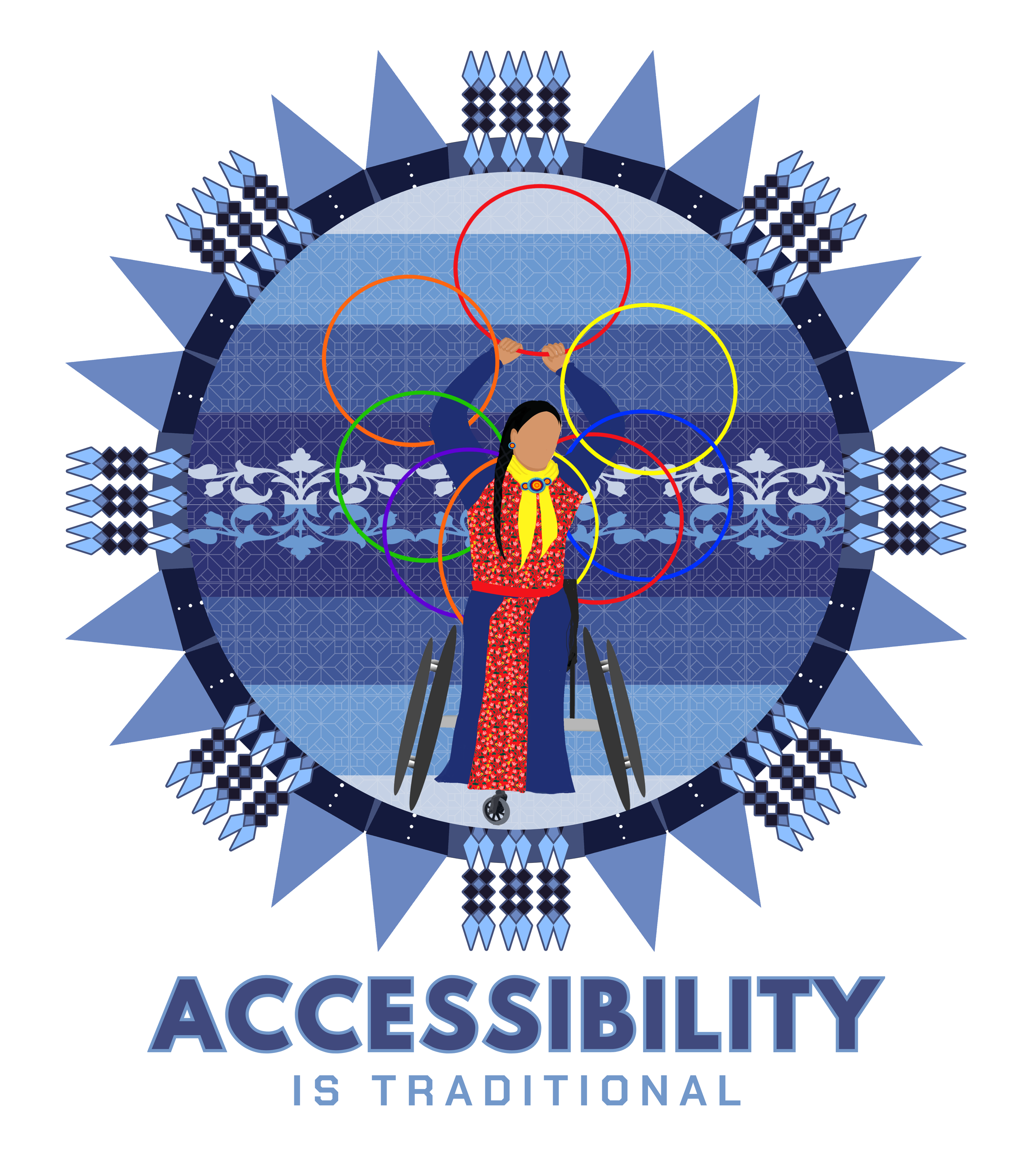
Art by Johnnie Jae
Image Description: Digital art on a white background featuring a Native woman hoop dancing in a wheelchair against a circular geometric design in various shades of blue with white text that reads, “Accessibility is Traditional.”
Indigenous Peoples’ Day recognizes the survival, sovereignty, and continued presence of Native peoples while challenging the whitewashed histories that have too often rendered us invisible on the very lands we have stewarded and called home since time immemorial. It’s the perfect opportunity to acknowledge Indigenous peoples as living communities in our present and future realities, not just our past histories.
It also gives us a reason to ask a harder question: Whose voices shape those realities within both Indigenous communities and the disability justice movement? Disabled Natives belong to both, yet our voices are largely missing from the work determining where both communities go next.
Nearly three in 10 American Indian and Alaska Native adults live with a disability, according to the Centers for Disease Control and Prevention. Native communities continue to experience some of the country’s starkest health disparities and highest rates of chronic illness. Those disparities can’t be separated from the history of colonization and anti-Indigenous federal policy, which resulted in forced removals, land loss, and disrupted Native foodways, families, cultural practices, and access to healthcare. The consequences of those disruptions haven't disappeared; they continue to shape health outcomes in Native communities.
Indigenous Peoples’ Day is an opportunity to raise visibility for the experiences of Disabled Natives, to look at how our Nations care for our people, and what needs to change. Tribal governments have a responsibility to serve their citizens — including children, elders, and disabled relatives — through decisions about healthcare, food, housing, and community support. The federal government must also answer for the lasting effects of its anti-Native policies and honor its treaty obligations to provide comprehensive, accessible, and culturally competent healthcare.
While governments have responsibilities, we can’t leave the work of caring for one another to them alone. We are family, and we all have a part to play in identifying barriers, challenging exclusion, and making room for disabled relatives to participate in community life.
Colonialism is disabling.
Disability can be present from birth or develop due to illness, injury, aging, environmental exposure, and other circumstances. Colonialism has also created conditions that contribute to illness and disability while making care harder to obtain. When our Native ancestors were forced off our homelands, they also lost access to the traditional food sources and medicines that they had relied on for generations. Assimilation policies and residential Indian boarding schools disrupted family structures and cultural knowledge, including the knowledge of how we cared for the most vulnerable in our communities.
The United Nations has documented barriers faced by Indigenous people with disabilities, including discrimination and unequal access to healthcare, education, employment, and other services. And available health data point to a much larger problem. A national study of Native elders found that 89.7% had at least one chronic disease — the most prevalent being diabetes, arthritis, and high blood pressure. American Indian and Alaska Native adults are nearly three times as likely as white adults to have type 2 diabetes, the CDC reports. Those figures can’t be explained by personal choices alone. The disabling stress of colonialism and racism — alongside where people live, what food they can afford, whether they can get medical care, the condition of their environment, and their ability to maintain traditional practices — all play a role in their health.
Colonialism has shaped Native understandings of health and disability. But disability justice starts with looking at the setting around a person and recognizing that access isn’t an individual’s responsibility to solve alone. A wheelchair user isn’t excluded from a building because they can’t climb stairs. They’re excluded when stairs are the only way in. Someone with chronic illness shouldn’t be less involved and included in their community just because they need to rest, stay out of the heat, or head home early. Caring for one another as family means paying attention to those needs and planning accordingly, rather than expecting each person to work around barriers on their own.
Being a good relative means paying attention.
Indigenous Nations each have their own teachings and histories about disability, and no single account can describe every community’s understanding. Still, many communities share similar ideas. In “Native American Worldview and the Discourse on Disability,” researcher Lavonna Lovern lays out several. Citing the work of Dr. Carol Locust, a Native physician, Lovern writes that many Native languages don’t have words that translate to “disabled,” “handicapped,” or “crippled.” A physical or mental difference is “only one element of the individual’s existence, not the defining element.”
Care comes down to thinking through — and making — practical decisions. Can an elder safely navigate a gathering? Can a wheelchair user reach the meeting space? Can a Deaf relative follow the conversation? Is there shade for someone who can’t tolerate prolonged heat? Is there somewhere quiet for someone who needs a break?
Those considerations belong in tribal offices, schools, websites, meetings, and cultural programs, too. Not every disability is visible. Chronic pain, fatigue, neurological conditions, and psychiatric disabilities can affect what someone can do from one day to the next. Asking people to push through those limits places the burden on them. Listening to disabled Native people about what we need is a better starting point in being a good relative, not just a caregiver or ally.
Disability justice belongs in sovereignty conversations.
Mainstream disability advocacy hasn’t always accounted for tribal sovereignty or colonization. So, disabled Native people have been doing this work for years. The Native American Disability Law Center works with Native people with disabilities in the Four Corners region on civil rights, education, healthcare, and access to services. The Indigenous Persons with Disabilities Global Network brings Indigenous perspectives into international disability rights discussions. But Indigenous organizing can also leave disabled people out when disability isn’t considered in community planning, cultural work, and political action. Disabled Native people can end up caught between both gaps.
Land, political authority, cultural revitalization, and self-determination are essential, but citizens also need meaningful ways to receive services, maintain relationships, practice culture, and exercise their rights. Disability justice is a core piece of this work and can’t be treated as a separate issue to address later.
Disability justice challenges that divide. Disabled Native people shouldn’t have to choose between being recognized as Indigenous and being recognized as disabled. Sovereignty includes all of our relatives.
Indigenous Peoples’ Day can be a call to action.
Disability justice looks at the circumstances surrounding a person rather than treating our bodies as a problem.
Colonial policies helped create many of the health and social conditions Native people continue to face. Health disparities, environmental hazards, poverty, inaccessible housing, unreliable transportation, and difficulty obtaining medical care compound those conditions. Someone managing an illness may struggle to get to an appointment, find stable housing, or secure support, all while lacking those supports can make their health harder to manage.
Indigenous Peoples’ Day can be more than recognition of Native presence. It can be a chance to consider how we care for one another and what we're building for those who come next. Disabled Native people have always been part of our communities. Our knowledge, leadership, labor, relationships, and experiences belong in the future of Indigenous Nations.
Care shouldn’t depend on whether someone is nondisabled. Building stronger Native communities means dealing with the conditions that make illness and disability harder to navigate and changing practices that leave people on the outside. Sovereignty should give our people more room to live, contribute, and lead — not force disabled relatives to push past another set of obstacles to have our voices heard and our presence recognized.