The Fingerprint That Could Not Clock In: How World Bank Biometric Standards Disable Teachers in Punjab
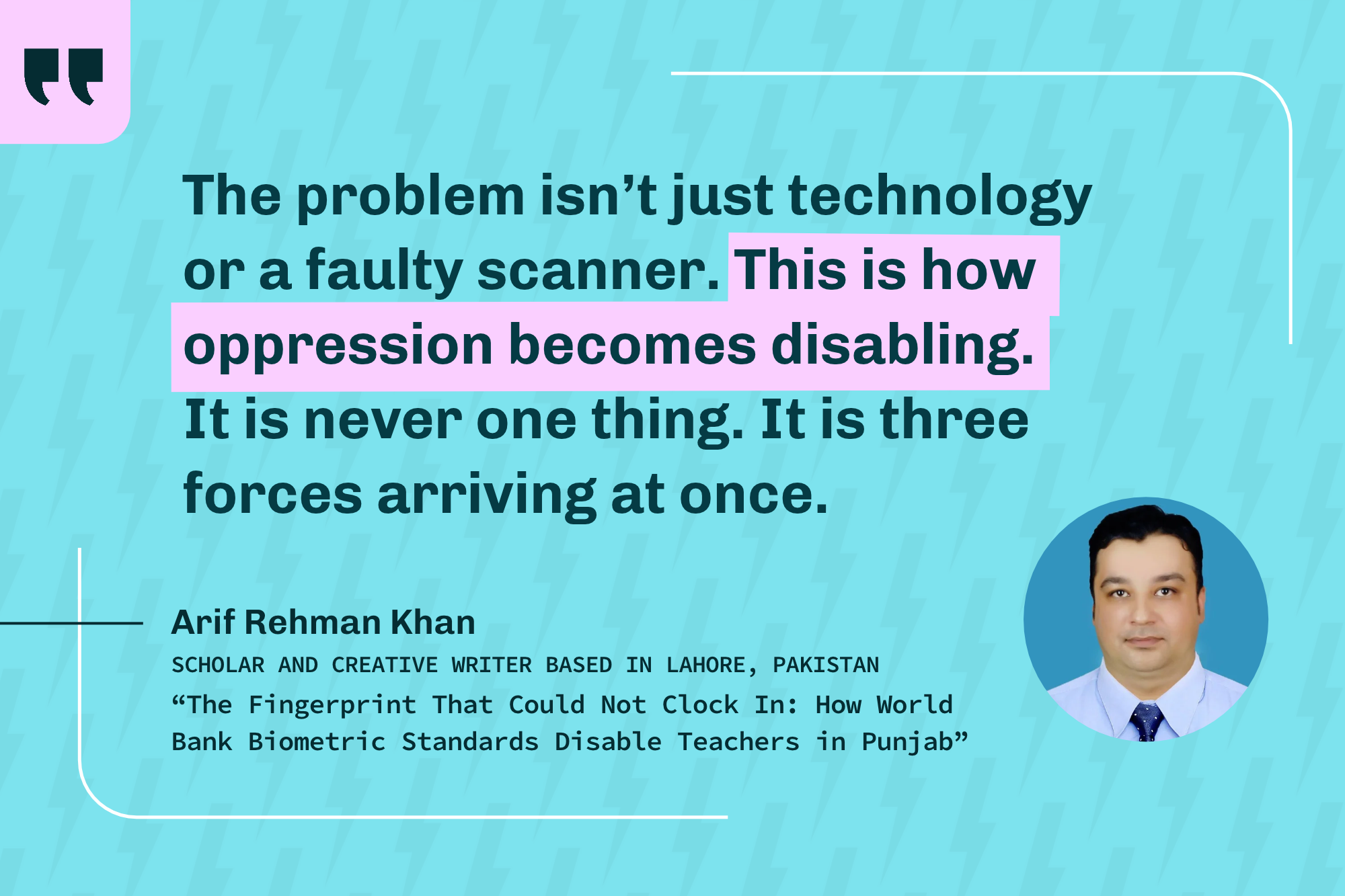
Graphic Credit: Jennae Petersen | Photo Credit: Arif Rehman Khan
Image Description: The graphic features a quote from Arif Rehman Khan, a scholar and creative writer based in Lahore, Pakistan: “The problem isn’t just technology or a faulty scanner. This is how oppression becomes disabling. It is never one thing. It is three forces arriving at once.” A circular headshot of Arif Rehman Khan, a South Asian man with short black hair, facing forward and looking directly at the camera with a slight closed-mouth smile. He is wearing a light blue collared dress shirt with a navy blue tie with small white polka dots. The background is a solid bright sky-blue. The quote and article title, “The Fingerprint That Could Not Clock In: How World Bank Biometric Standards Disable Teachers in Punjab” appear in dark teal text on a turquoise background with a subtle lightning-bolt pattern.
Every morning at 7:59 in my cousin's government school in southern Punjab, Pakistan, forty teachers line up to press their thumbs on a small black box.
The box wasn’t there two years ago. It arrived as part of a World Bank-supported Punjab Education Sector Project III, which was designed to increase school participation and improve teaching practices in low-performing districts. The donor money came with a condition: prove every teacher is present, every day, with biometric data to meet “international accountability standards.”
My cousin Sajid is 34. He teaches math to Class 7 (seventh grade in the United States). He lost three fingers on his right hand to a wheat thresher when he was nine. The prints on his left hand have been worn smooth by twenty years of writing on a blackboard; chalk dust has settled deep into the grooves the machine needs to read.
He presses his finger to the scanner. The device says, in English, “Finger not recognized. Try again.”
He wipes his hand on his shalwar. He presses again.
The scanner flashes red. The headmaster sighs and marks him absent in the paper register, even though his students can see him standing in the room. At the end of the month, he is denied three days of pay.
But Sajid is not absent. He is illegible.
ISO/IEC 19794-4, the international standard for fingerprint image quality, is simple and clinical on paper. It is the global benchmark for fingerprint images. It assumes a whole, centered, high-contrast fingertip. It was written with the hands of office workers in Geneva and international travelers passing through border control in airports in mind.
This kind of standardized, idealized fingerprint leaves little room for the diversity of real hands. It was not written for a farmer’s son whose hands have been worn down by years of manual labor, or a person with a limb difference that does not fit the expected template.
In Punjab, a 2023 labor survey found that 40% of manual workers over the age of 30 have fingerprints too worn or scarred for low-cost scanners to read, altered by henna stains, burns, thresher injuries, brick kilns, or years of washing dishes. The ISO/IEC 19794-4 standard calls these unreadable prints “failure to enroll.”
The language is revealing. The system has failed to recognize a person, yet the failure is recorded as a defect in the body. It is not the system that fails to do its job. It is your body that fails to enroll.
The machine does not disable on its own, but works in conjunction with institutions that enact rules about who counts as a legitimate worker. The problem isn’t just technology or a faulty scanner. This is how oppression becomes disabling. It is never one thing. It is three forces arriving at once.
First, colonialism: A donor in Washington, D.C. says, we will only fund your schools if you track attendance our way. The district education officer cannot say no, because the entire district budget depends on it.
Second, capitalism: The cheapest scanner wins the government tender. Sajid’s school is provided with a cheap, $30 optical sensor that demands a perfect print. A better, more expensive capacitive sensor could have read his hand, but it costs $120. Austerity chooses the disabling option.
Third, ableism: The machine assumes there is a standard body that clocks in. If your fingers cannot produce the expected pattern, you are not a worker. You are a problem to be solved.
I know the feeling of that morning queue because I sometimes stand in it. I am a writer with chronic hand pain. By evening, after a day of typing with assistive tools, my own fingerprints swell and fade. My phone won’t unlock with my thumbprint. I try my index finger, then my knuckle. This is what disability culture has always taught: to be nondisabled is to assume your body will always fit the machine. Until one day, it doesn't.
Sajid does not have a disability card. In Pakistan, disability certification requires a hospital board, a bribe, and a label that many men refuse out of shame. He does not call himself disabled. But at 7:59 a.m. every day, the state disables him. That liminal space, not disabled enough for benefits, yet too disabled for the machine, is where many disabled people in my country live.
This is why biometric attendance is not an education story. It is a disability justice story about who gets to be counted as present.
Every issue is a disability issue if you watch it long enough. In 2025, Punjab extended the same biometric system from schools to basic health units and to Benazir Income Support Programme, Pakistan's federal cash transfer program for low-income women. Women who roll dough all day then try to use fingerprint ATMs to claim their money. But they are losing that quarter’s Rs. 10,500 — about $38 — because the machine says “not recognized.” The government calls it leakage prevention, a process designed to discourage worker fraud and duplicate payments. I call it a new way to make people disappear.
But Sajid’s students refuse to let him be erased. They have invented a counter-technology. On the back wall of his classroom, in white chalk, they have started a register of their own.
“Sir Sajid was here - 14 August.”
“Sir Sajid was here - 15 August.”
Twenty small hands writing the name of a man the black box says was never there.
It is not biometric. It is not ISO-compliant. It cannot be uploaded to a World Bank portal. But it is true.
He leaves a print no scanner will ever read, but every child in the room can see. He is here.
That is disability culture: we keep each other’s attendance, in a language the machine never learned to read.