The Body I Borrow to Leave the House
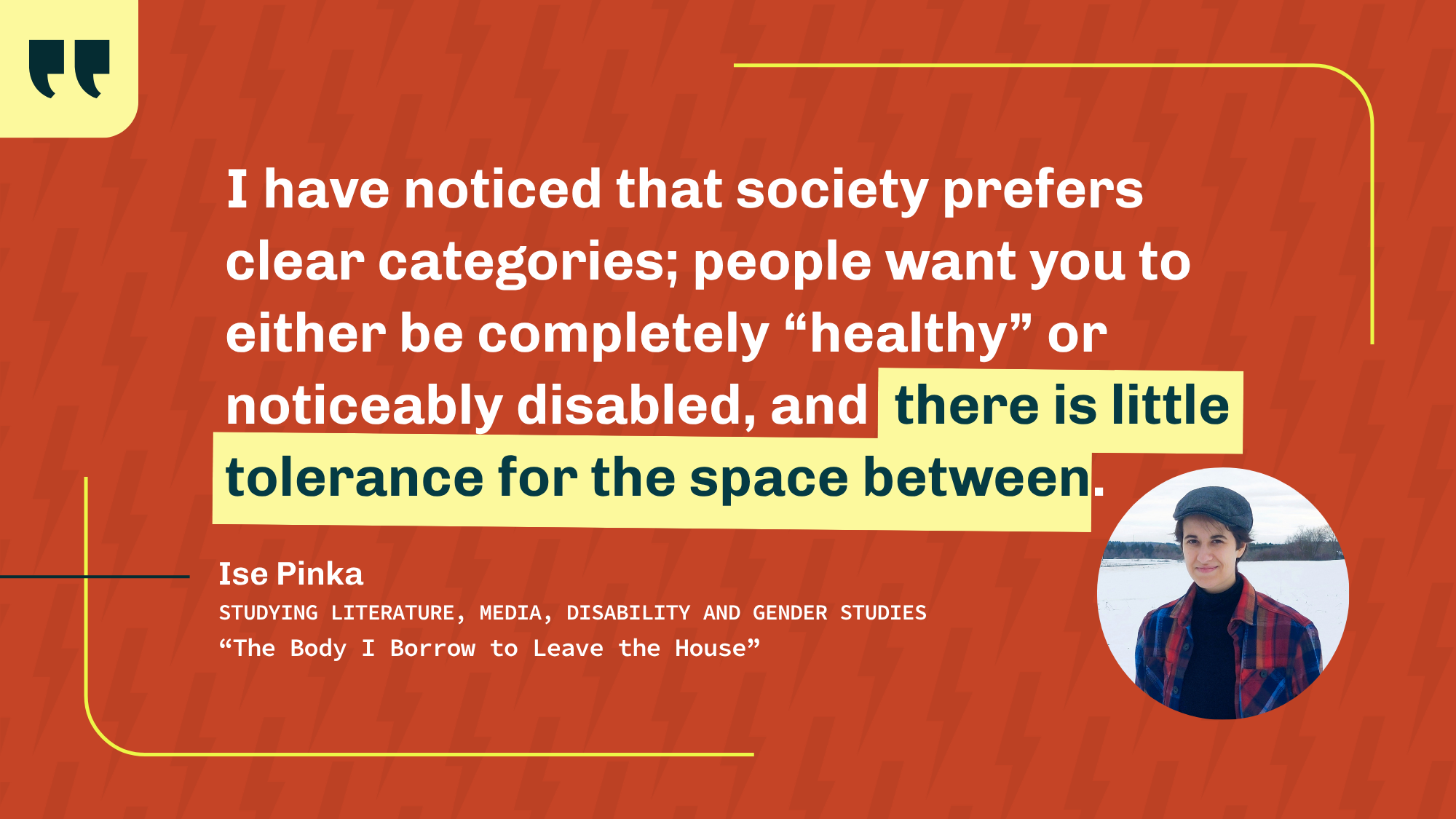
Graphic by Jennae Petersen
Image Description: The graphic features a quote from Ise Pinka that reads: “I have noticed that society prefers clear categories; people want you to either be completely ‘healthy’ or noticeably disabled, and there is little tolerance for the space between.” The phrase “there is little tolerance for the space between” is highlighted in pale yellow for emphasis.
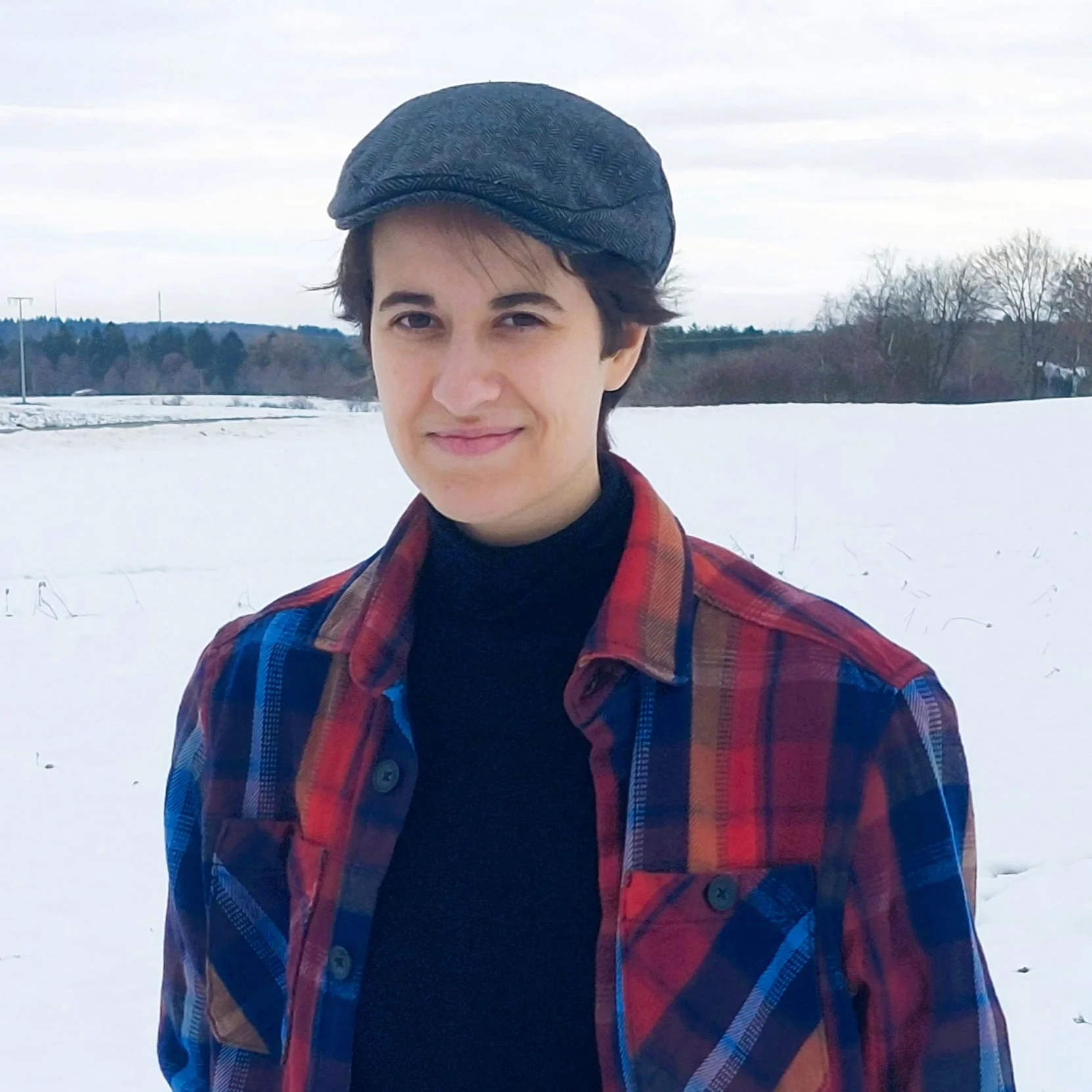
Below the quote, Ise Pinka is identified as studying literature, media, disability and gender studies, and the title of the accompanying piece is “The Body I Borrow to Leave the House.” The quote appears in large white text on an orange background with a subtle lightning-bolt pattern, accented by thin yellow graphic lines and quotation marks in the upper-left corner. A small circular color portrait of Ise appears in the lower-right corner, showing them outdoors wearing a dark cap, a red-and-blue plaid overshirt, and a black turtleneck against a snowy landscape.
Every morning is full of decisions.
Even when I lay out my clothes the night before, thinking about how I want to dress in terms of gender — whether I will choose what feels safest and most legible or what feels most truthful — I still have to make choices in the morning. I prepare for the weather because I need that certainty, and I plan my breakfast and follow my morning routine every day, but I cannot decide in advance which form of mobility will match my body that day.
That uncertainty culminates in the front hallway of my apartment. It is here that I must finally decide the form in which I will meet the world. Do I leave without any mobility aid? Do I take the crutches? Or do I sit in the wheelchair? This is an existential choice: the decision determines how much of a self I can afford to be that day.
When I leave the house without a visible aid, I choose camouflage. In a society that equates health with productivity and compliance with social and economic norms, I pass unnoticed. This invisibility offers temporary protection from questions, curious stares, and unsolicited commentary. But it exacts a cost. In the crush of the subway, in the press of lines, in the unpredictable rhythm of the city, my pain travels with me, unseen.
When I reach for my crutches, the dynamic changes immediately. The staring comes first. It is direct and persistent — almost judgmental — as if my body poses a question that demands investigation. At the same time, people step aside and cautiously create physical distance. But that care is soon replaced by verbal intrusion.
“What happened?” “Get well soon!” The tone is sympathetic, sometimes curious, and occasionally anticipatory of an interesting story — perhaps there was a skiing accident in the Alps, a dramatic bicycle accident, or a misjudged jump while climbing. In other words, an injury that’s unfortunate but impressive, temporary disability with a clear beginning and a predictable end.
I wish.
Chronic illness follows a different narrative. It offers no clear course of crisis and recovery, let alone a decisive turning point when everything is fine again. Alas, my osteoarthritis is a progressive condition. In the face of these questions, I can gently confirm the stranger’s hope for recovery by nodding reassuringly, or I can explain that there will be no cure.
For me, as an autistic person, these encounters are exhausting. And the crutches make them even harder, since they occupy my hands, which I rely on to self-regulate in overstimulating environments; the physical distance they create costs me neurological effort. In those moments, experiences of ableism converge from two directions, restricting my autonomy with both physical and neurotypical expectations.
In a wheelchair, the situation changes again. People are much less likely to ask me questions. The distance between others and my body becomes more predictable and the pain more manageable. I can pace myself, build up reserves, and think beyond the immediate present. And if I need to regulate, I have ready access to my hands. For me, choosing the wheelchair means choosing self-determination. But I am further restricted by structural barriers — such as inaccessible buildings without elevators and ramps — and societal expectations.
Since I can theoretically stand or take a few steps, even if it is painful, I do not fit the rigid, black-and-white image of disability that many people have. I have noticed that society prefers clear categories; people want you to either be completely “healthy” or noticeably disabled, and there is little tolerance for the space between.
I’m afraid of being confronted about people’s (mis)perceptions, because, in the minds of some observers, it makes me a fraud. Stories about the alleged misuse of parking permits or disability benefits hang in the air like a permanent, invisible suspicion. That is why I do not dare to stand up from my wheelchair to reach a high shelf in the grocery store: I always feel the need to justify myself preemptively. Ableist stereotypes again interfere with my ability to navigate.
In addition to confusing people with my body’s refusal to adhere to others’ notions about disability, the mobility aids that grant me autonomy are expensive. That’s yet another factor in my daily decision around which body I bring with me into the world. Every repair and purchase costs time and money, requires negotiation with the insurance company, and involves the dehumanizing task of proving my own needs to another adult. From this perspective, independence becomes a commodity and accessibility a budget item. The fundamental right to move around without pain depends on paperwork and purchasing power; the aids I need to participate in public life are treated as optional expenses rather than structural necessities.
This puts me in limbo. I am too impaired to move effortlessly through the world, but too functional to fit the rigid archetypes that grant access to care. When I rest, I fear I am not doing enough. When I push through the pain, I fear I am not taking good enough care of myself. The effort lies in the daily necessity of strategically choosing my body. Each option offers both relief and risk. Every decision is a balancing act between pain, visibility, autonomy, and social legibility.
My apartment hallway is a political space. It reveals how persistently our society presses bodies into coherent narratives. Mine resists such clarity.