Pooled Blood
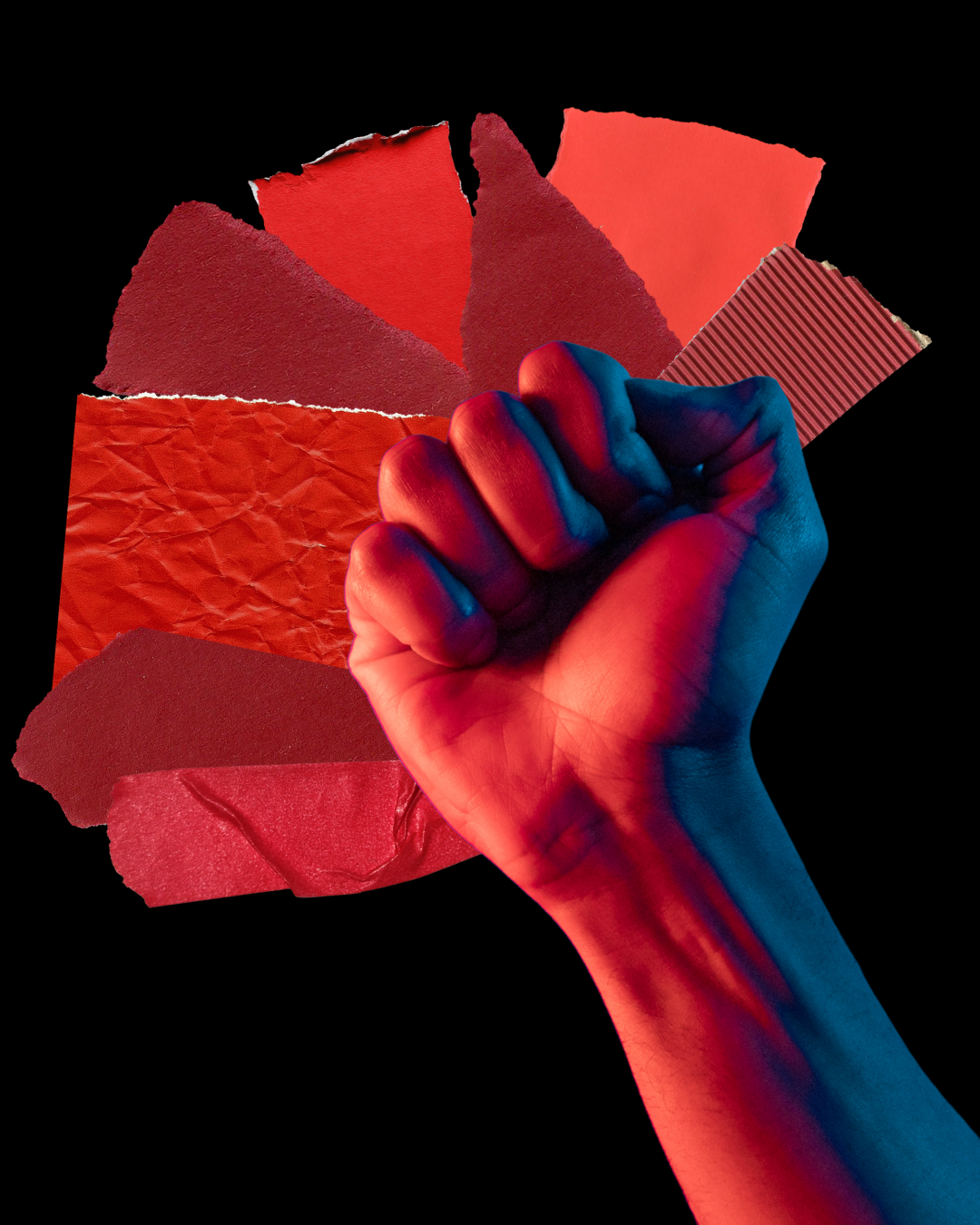
Photo illustration by mav vega
Image Description: Mixed media photo illustration features red-tinted arm and fist over layered scraps of paper in varying shades of red, all on a black background.
My right leg had swollen to three times its size, the towel under me was damp with blood, and a cop was at my window talking about a ticket.
My then-partner said to the state trooper: “She is having a miscarriage and just tore her ACL.” The trooper gave us a choice: he could call an ambulance to the local hospital or write a speeding ticket. At that moment, I wanted to smear “ACAB” on his face in my blood.
I went to therapy instead.
We were driving from the East Coast back to Chicago because my health insurance was through my university. I could only get healthcare in the city and could not afford to pay out of pocket while visiting my family.
My knee hurt, and my partially dilated cervix was ripping through my abdomen, but the real disabling event was all of these things happening in an abusive relationship.
We started the drive at 5 a.m. because he hit me in my mother's house. He hit me, while my knee was the size of a watermelon, in my family home, while I was miscarrying. A family member heard us fighting, and I was ashamed, so we fled.
When we reached the city, I went back to the same hospital that put the stitches in my face when he broke a Mason jar on it. My hospital records detail various irregular blood results, a history of domestic violence, a collection of autoimmune diseases and health problems. The hospital did not consider the torn ACL to be an emergency, so it would take a year for me to get imaging.
In the year between that torn ACL and imaging, I had a high-risk pregnancy. I was diagnosed with preeclampsia at six months. Left leg swelling led to a two-week hospital stay, which resulted in constant blood sugar drops from too much insulin and not enough food. It all led to a premature birth. They had to cut me open, a C-section for my tiny baby, a surgery to keep us both alive.
One day, while I was exhausted from giving her all her nighttime feeds and working full time, my then-partner asked me if I was going to get my ACL fixed. My mind was filled with all he could do to me while my knee was locked up in a brace. So instead of leaving, I made excuses for him.
When I walked into the ER the night he slammed the Mason jar on my face, I was triaged immediately. Blood was dripping down my face from multiple gashes. I refused to give a statement to the cops. What would they do? What would jail do?
Then, the doctor overseeing the ER that night came to talk. He kept me there for six hours, begging me to go anywhere but back to the apartment where my abuser stayed.
I went back anyway.
We are so strict about what is disabling because when we pull back the curtain, the inevitability of disability destabilizes the ableism that allows fascism to thrive in the United States.
Yes, my knee popped out of place when I walked, destabilizing movement. My preeclampsia meant my swollen body could only move so much without immense pain, but was the limited movement more disabling than my brain after he choked me the first time?
You see, Mama didn’t raise a quitter, and I can handle pain better than other people, so I could suffer, proudly. I could handle the systematic neglect, the medical industrial complex, the interpersonal violence — and survive. He was failed by institutions, and it broke him. In a country where prisons are filled with disabled men of color, can I live my values and send my partner to jail?
I was raised to be a strong woman, even disabled; the necessity of survival was a trait handed down by the women in my family. Wella survived beatings, so Mommy could survive beatings, so I could survive beatings.
The legacies of colonialism, patriarchy, the things white supremacy stole from us and replaced with myths — all of these impact my experiences of domestic violence while disabled, fat, queer, and Boricua.
Domestic violence had a stranglehold on my body. It showed up in my bloodwork, it was visible in the bruises under my makeup, it can still be seen in how I jump at sudden noises, in the ways my brain and body cope with what I experienced, in the scars on my face.
The domestic violence pamphlets and printouts at the back of my post-visit summary offered no real intervention. Social workers pushed to the brink of their capacity could not give me relief or support.
We exist within a connection of systems and structures that create the conditions for disabling events and then push disabled people to their deaths as quickly as possible. In July 2025, I had a minor stroke.
It was a warning that my life needed to change.
Now, it is 2026. I am safe. I’ve been to the doctor more times in the past two months than in the past five years. My blood pressure is back to normal. I’m still looking for third and fourth jobs to pay my bills and cover my collections. The intimate partner violence is over, but I am still getting mollywhopped by the structures of inequity that increased my risk of experiencing domestic violence in the first place.
When I think about my swollen legs, ACL tears, and miscarriages, I wonder if the pooled blood was more medically urgent than an abusive relationship.
I will have surgery next month. I will recover alone. No risk of violence from a partner, just the loneliness of disability in a society that hates me all the same.