
Listen to Black Disabled People on the BAFTAs
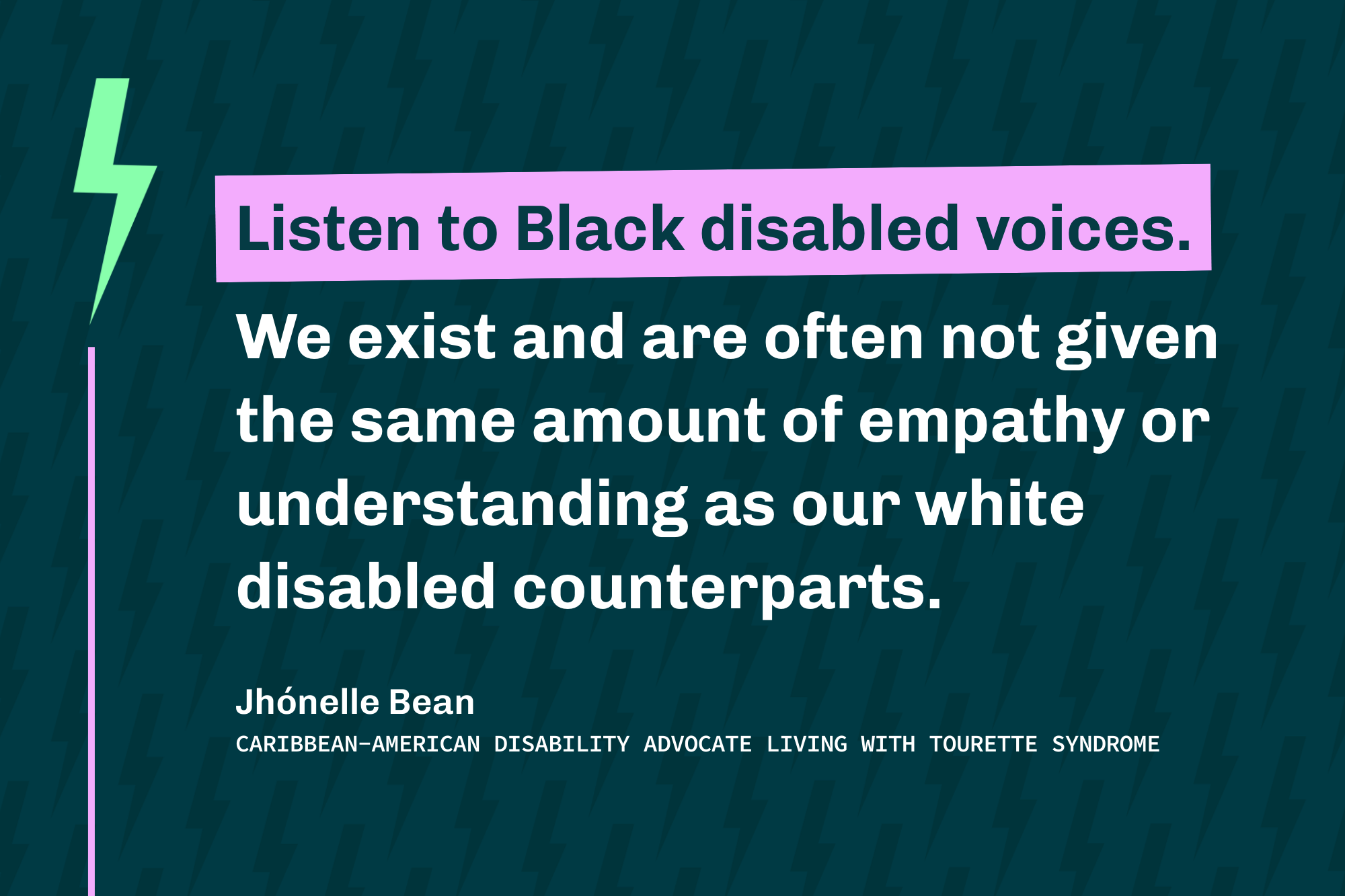
Image Credit: Jennae Petersen
Image description: Quote graphic on a dark teal background with a green lightning bolt icon. Pink highlighted text reads, “Listen to Black disabled voices,” followed by a quote from Jhónelle Bean, Caribbean-American disability advocate living with Tourette Syndrome: “We exist and are often not given the same amount of empathy or understanding a our white disabled counterparts.”
Last week, John Davidson ticced the N-word while actors Michael B. Jordan and Delroy Lindo were on stage at the EE BAFTA Film Awards. I have seen a lot of discourse on the topic on social media and have heard many people’s opinions; some hurtful, some ableist, and some racist. I'd like to take a moment to share my thoughts and experiences as a Black woman with Tourette Syndrome.
Social media can often exhibit a lot of “all or nothing” thinking. Immediately following the incident, social commentary online split between: “He has a disability. If you’re offended, then you’re ableist,” and “That word is harmful. If you don't understand that, you're racist.”
But here is the simple truth: Tics are involuntary and out of our control, but just because you didn’t intend to harm someone doesn’t mean that they weren’t hurt by it, and our hurt shouldn’t be policed.
I always want to set myself up for success and avoid embarrassment, but I sometimes still experience shame when ticcing and feel like I’m distracting or bothering people. Even though my movements and sounds are involuntary, they draw attention if I’m in an environment where everyone is quiet and sitting still and I’m not. I can imagine the relief Davidson felt being told the event was pre-recorded and that his tics would be edited out. I can also imagine how daunting it must have felt to learn that one of his tics was likely intentionally left in the television broadcast of the event. On the flip side, I can imagine the shock and visceral unease in Jordan and Lindo’s stomachs once they realized what was shouted out at them while on stage.
Living with Tourette Syndrome requires a lot of advance planning. I have to plan and think ahead of how my tics could interfere with what I’m doing and where I’m going. If I were going to a large event like the BAFTAs, I would think about where I would be sitting, if I would draw attention to people around me if I was ticcing a lot, how loud the environment would be, if there were any moments where everyone is expected to be quiet, how close I would be sitting to people, if I would be on camera, and how long the event would be — just to name a few.
Living as a Black woman also requires thinking ahead. I think about my safety and how my presence will be perceived by others. If I were going to an event like the BAFTAs, I would think about whether other Black people or people of color would be present or if I would be the only one, if the area of town I’m going to is known to be safe for someone who looks like me, and how safe I feel to fully be myself when socializing with others.
I’ve adapted these tactics based on previous experiences I and others have had in society. But it’s hard to plan when the powers that be are working against your best interest. I believe the BBC intentionally pitted two marginalized groups against each other in this incident for the sake of ratings. The broadcast was not live; it was delayed by two hours in the U.K. and six hours in the U.S., yet the television network left this hurtful slur in, despite editing out other slurs ticced by Davidson, a director’s use of the word “piss,” and filmmaker Akinola Davies Jr. saying “Free Palestine.”
Why make those edits, but leave in something that was embarrassing for Davidson and hurtful to MBJ and Lindo? That’s where the racism truly shows up; that was a decision (and one that probably had to be run by several different people).
There are so many Black individuals in the disability community, but our voices are often not valued or listened to. Being from both worlds, I feel the harm this has caused from both sides, even as Black disabled people are routinely not given the same amount of empathy or understanding as our white disabled counterparts.
The fight for racial justice and equity in the Black community must include the fight for Black disabled people, just as the fight for disability justice must include Black disabled people. These are not separate fights, but one and the same.
Listen to Black disabled voices. Understand that tics are involuntary and not our inner thoughts. Understand that the world has historically policed how Black people are allowed to feel, telling us to “get over” so many things.
Let’s move forward remembering both are true.
