Graphic Credit: Jennae Petersen | Photo Credit: Angelica Brenzel
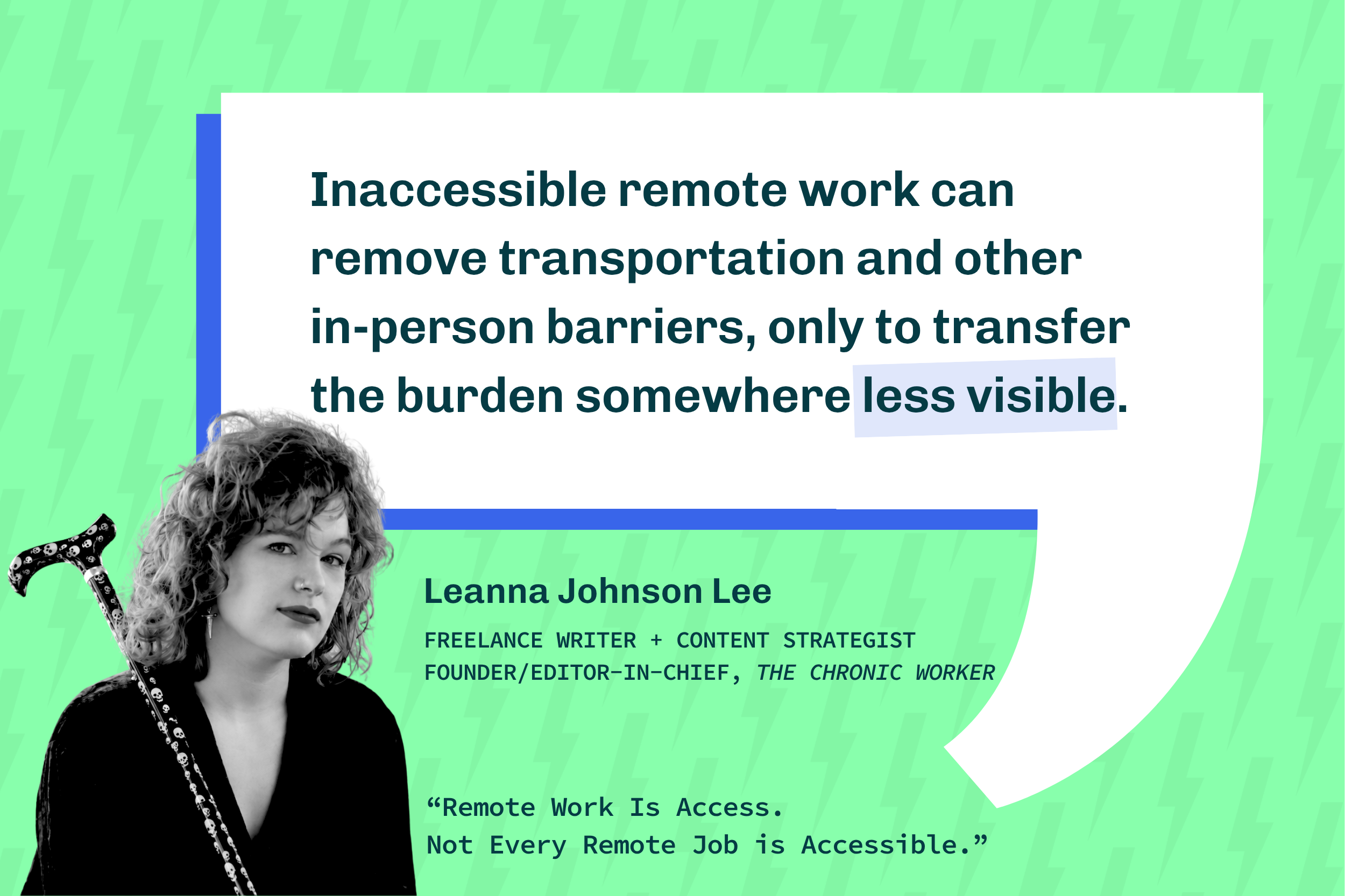
Image Description: Quote reads: “Inaccessible remote work can remove transportation and other in-person barriers, only to transfer the burden somewhere less visible.” The words “less visible” are highlighted in pale blue. The quote is attributed to Leanna Johnson Lee, a disabled freelance writer, content strategist, and founder/editor-in-chief of The Chronic Worker, from the article “Remote Work Is Access. Not Every Remote Job is Accessible.” The graphic features a bright green background with a subtle lightning bolt pattern and a large white quotation mark. At the lower left is a black-and-white portrait of Leanna, who has curly, shoulder-length hair, wears a black top, and poses beside a decorated cane.
Remote work has saved my ass thousands of times. It has given me the freedom to manage my life with disability while freelancing. It has also allowed me to work full time from home when I couldn’t in person. Clocking in remotely reduces or eliminates commutes, inaccessible workspaces, overstimulation, workflow disruptions, and potential exposure to illness.
Between 2022 and 2024, folks with physical disabilities saw a whopping nine to 11% increase in full-time employment, according to research published in June by American Economic Review: Insights. Remote work alone accounted for 68 to 85% of the rise. That’s pretty wild.
Remote work can make our lives more accessible in many ways. By working from home, we can manage our symptoms privately. We can spend less time and energy navigating office spaces and making small talk and more preparing for and organizing our days.
But being able to work remotely doesn’t mean the work itself is accessible. A remote job is truly accessible when its schedule, workload, communication, and expectations accommodate, and can be sustained by, people with different capacities. Unfortunately, employers often fall short of making that a reality for disabled workers.
Remote is still a place of business.
A remote job may allow us to choose where we work, but that doesn’t mean it gives us the freedom to choose how we spend our time. It can still control when and how we work, how quickly we respond, and whether we need to communicate synchronously. Our workplaces also dictate how heavy our workload is and when we can rest or recover. We can’t always choose our breaks.
When I briefly worked full time on a marketing team, I learned pretty early on that multiple hours of back-to-back, camera-on video meetings were common. For the first few weeks of that job, I was dealing with a massive episode of major depression. I developed headaches and my vision went blurry due to the extended screen time.
I quickly used all the energy I’d saved by working remotely to stay alert and focused for more than eight hours at a time.
If a job has rigid hours, large blocks of meetings, or limited autonomy but is fully remote, it can still be inaccessible.
Inaccessible remote work transfers the burden.
Moving a job to the worker’s home doesn’t automatically make the work more accessible.
Inaccessible remote work can remove transportation and other in-person barriers, only to transfer the burden somewhere less visible. This is the disability tax, also known as the disability squeeze or “crip tax.” It refers to the extra time, energy, money, and resources disabled people use to navigate all the systems in our lives that are built for nondisabled people.
Maybe the energy you saved by not commuting gets consumed by meetings, your flexibility becomes unpaid evening or weekend work, or you paid out of pocket for an ergonomic chair or screen reader software an employer wouldn’t provide. Maybe you find yourself working longer hours to “make up” for taking care of small personal tasks at home or spending limited free time explaining why you need live captions for meetings. And when these levies get overwhelming, our non-work lives get squeezed out, leaving less and less time to rest, spend time with a partner, or cook healthy meals.
The right remote work can decrease that tax. Inaccessible remote work practices can shoot it skyward.
Accessibility work is sustainable work.
If you press a button to open a door, and it works well some of the time, but it keeps breaking, it’s a terrible button.
This is a part of accessibility that we don’t talk about often. Accessibility doesn’t mean one thing works for one person one time; it requires sustainability. For a job to be truly accessible, a worker should be able to remain in it over time through changes in capacity. A disabled worker may be technically capable of meeting every job requirement, but if they have to sacrifice medical care, household tasks, relationships, and recovery to do it, the work costs more than it pays.
Working full time was a huge strain on me and I had to set up accommodations and boundaries, be honest when I was at capacity, and rest a lot. Even then, I still had to manage the effects of long hours on my body. My health and mood suffered.
Common solutions like flexible hours are great, but their effectiveness in making work sustainable depends on whether you’re still expected to be immediately available, complete a full workload in less time than it should take, or make up for every health interruption.
A person may be able to complete the work and still be paying an unsustainable price to keep their job.
Truly accessible remote work changes the experience, not just the zip code.
In my more than 13 years as a disabled worker, I’ve held one full-time job. If it hadn’t been remote, I wouldn’t have been able to work at the time, so I’m thankful for it.
But accessible remote work requires more than a location change; it requires a change in approach. It requires trust, respect, and a commitment to supporting workers as individuals.
This might look like an employer offering more autonomy versus requiring you to ask permission every time you need to step away from your desk or complete routine tasks. Or reducing “green dot monitoring” so there’s no unspoken expectation of being on camera all the time. It could also look like async alternatives to unnecessary meetings, or a schedule built to flex with fluctuating capacity.
Whatever the case may be, remote work has to be sustainable for you, the worker. If it’s not, it’s not accessible.
So, here’s a challenge for you. The next time you’re working your remote job, ask yourself these questions: Does this job reduce my total burden or just move it back to me? Can I have a flexible schedule without making up the work after hours? Can I sustain this job without sacrificing my health or home life?
I really hope the answer to each one is “yes.” But I doubt it.
Remote work is indisputably a huge step forward in workplace access for disabled folks. It opens a lot of doors that we’ve been locked out of for decades; it’s too important for employers to implement it poorly and say they’ve “solved” accessibility. Employers must fulfill the promise of accessible remote work.